Get Full Government Meeting Transcripts, Videos, & Alerts Forever!
Get email alerts on the Economic Development Pilot topic
No spam. Unsubscribe anytime.
Greater Des Moines Partnership proposes one‑year pilot to boost Polk City commercial growth
Summary
The Greater Des Moines Partnership pitched a one‑year pilot for Polk City that would dedicate 15 hours per week of Partnership staff time to local business recruitment and place‑making, funded by a $50,000 pilot budget plus a $2,500 investor fee to access baseline services. Council members asked for concrete KPIs, clarification on scope, and evidence the city’s market could support the targeted businesses before committing taxpayer funds.
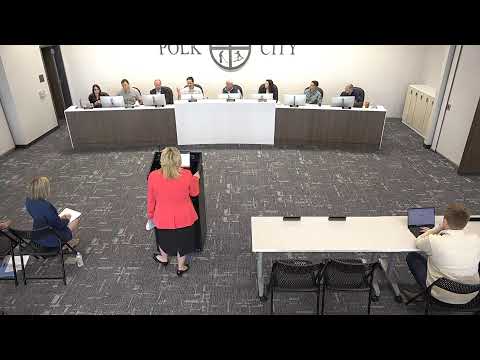
Polk City on April 13 heard a presentation from the Greater Des Moines Partnership proposing a one‑year pilot that would dedicate Partnership staff time to local economic development, business recruitment and visitor capture tied to the nearby lake.
Tiffany Tauschek, president and CEO of the Greater Des Moines Partnership, opened the session and described the Partnership’s regional work and scale. "We currently have 940,000 people living in our CSA," she said, framing Polk City participation as part of broader regional momentum that the Partnership says includes billions in capital investment under way.
Stacy LoVan, the Partnership’s senior vice president of economic development, said the pilot is designed to help Polk City accelerate retail, dining and service‑oriented commercial growth that matches recent residential development and lake visitors. "So, we are proposing 15 hours a week of paid staff support where we would have a staff person. They would spend 15 hours of their time working specifically on Polk City," LoVan said, describing a mix of on‑site office time at City Hall for local meetings and remote outreach to prospects and developers.
LoVan listed pilot focus areas that could include a commercial growth strategy, targeted retail and dining recruitment, lake‑to‑town visitor capture, downtown activation, developer and site readiness, and help identifying grant funding for implementation. She said deliverables and metrics would be co‑created with Polk City, with monthly activity reports and leadership check‑ins at six months and one year to evaluate progress.
On costs, LoVan said Polk City would join the Partnership as an investor at $2,500 to access baseline services, and the Partnership estimated roughly $50,000 for the one‑year, 15‑hour/week dedicated staff resource. The Partnership described the dedicated person as a new hire who would tap into the Partnership’s broader economic development team and resources.
Council members welcomed the concept but pressed for specifics. One council member said Polk City’s proximity to Ankeny and Grimes and limited highway access make the local market different from larger suburbs, and asked what practical experience the hire would need to provide candid, useful feedback to both businesses and the city. Another council member emphasized that "the rooftops" — the local household base — drive retail viability and urged the Partnership to focus first on data showing what Polk City’s demographics can support.
Council members also sought measurable short‑term activity metrics to justify an initial investment of taxpayer dollars: suggested measures included number of local businesses met, outreach attempts to prospective companies, prospects engaged, developer conversations, and monthly activity reporting that shows progress toward longer‑term business leads.
The Partnership said it tracks metrics regularly at board and staff levels and offered to work with Polk City to identify appropriate KPIs and reporting cadence. Presenters thanked the council and said they would return to discuss details after the council had time to consider the proposal.
The work session included no formal vote on the pilot; the council moved to adjourn and scheduled the regular 6:00 p.m. council meeting to follow.