Get Full Government Meeting Transcripts, Videos, & Alerts Forever!
Get email alerts on the Waste Management topic
No spam. Unsubscribe anytime.
Metro Waste Authority outlines recycling, compost and battery programs; warns of fire risk from batteries
Summary
Metro Waste Authority told Polk City officials it serves about 110,000 homes, handles roughly 2,000 tons of Polk City garbage annually and 352 tons of recyclables; its battery-collection effort surpassed a 10,000‑lb goal with 14,000 lb in nine months, while facility fires tied to batteries remain a concern.
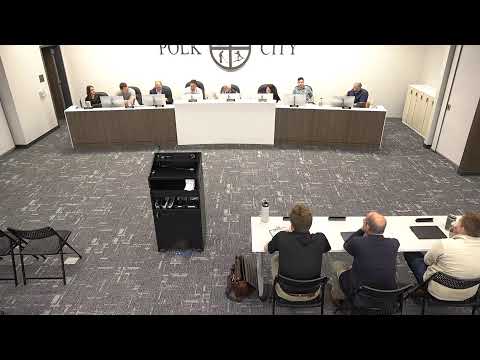
Leslie Erlbacher, chief operating officer of the Metro Waste Authority, told the Polk City Council that the agency has evolved from running a single landfill in 1969 to operating two landfills, two transfer stations, a hazardous‑waste facility, a compost site and recycling centers that serve member communities. "My name is actually Leslie Erlbacher and I am the chief operating officer at Metro Waste Authority," she said during the presentation.
Leslie and Caleb Erlbacher (vice president of public affairs) emphasized services available to Polk City residents: curbside garbage and recycling collection, a household-hazardous-waste program, a compost product (GrowGold Compost) for retail sale, and local recycling drop-off points in Polk City. Metro Waste Authority reported that Polk City disposes of roughly 2,000 tons of garbage annually (including spring cleanup) and about 352 tons of recyclables through the every-other-week collection schedule. MWA said it serves about 110,000 homes regionally.
The agency highlighted customer-service investments — handling roughly 62,000 telephone interactions annually and about 8,000 chatbot contacts — and internalized cart-delivery and repair work that allowed MWA to repair roughly 10,000 carts last year. Leslie also described MWA grant programs available to member communities and nonprofits.
On safety, Leslie called attention to fires caused by rechargeable batteries in collection and processing equipment. She said the agency recorded nine fires so far in 2026, compared with 21 in 2025 and eight in 2024, noting battery-related incidents drove the increase. MWA reported its first-year battery-collection goal was 10,000 lb and that it had collected about 14,000 lb in nine months. The presentation closed with an offer to assist Polk City on program grants, education and school outreach to improve recycling behavior.