Get Full Government Meeting Transcripts, Videos, & Alerts Forever!
Get email alerts on the Transportation.ev Charging topic
No spam. Unsubscribe anytime.
West Newbury approves EV‑charger signs, funds one‑year ChargePoint contract amid concerns about subsidy
Summary
The Select Board approved signage for Page School EV chargers and authorized a one‑year ChargePoint contract paid from the EV charging revolving fund, while directing staff to return with usage and cost data after members raised concerns that the town is subsidizing electricity costs.
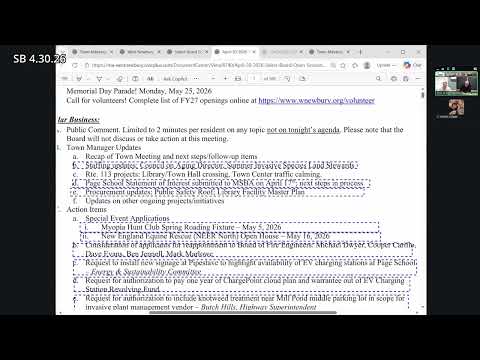
The West Newbury Select Board voted to install three informational signs (two at the upper parking lot and one at the middle lot) for the electric vehicle charging stations at Page School and approved paying a one‑year maintenance/management contract to ChargePoint from the town's EV charging station revolving fund.
Board members discussed details of the signage — placement at the top of the hill and the next lot down and a 12-by‑18 size — and asked staff to confirm hours of operation with Page School administration before final fabrication. The board approved the content as presented and asked staff to work with school officials on any timing restrictions or school‑specific needs.
On the EV contract, staff said a five‑year option had been more cost‑effective on paper but the three‑year and one‑year quotes produced “sticker shock.” The one‑year proposal under consideration was approximately $6,280; an earlier three‑year figure provided by the vendor was about $15,700. The board authorized using the EV revolving fund to pay the one‑year bill but asked staff to prepare a follow‑up report with detailed usage, electricity costs and fund balance projections.
Board members noted the town currently pays the utility bills for the charging stations and that earlier charging rates (35¢ per kWh charged to users vs. 26¢ per kWh town cost cited in prior months) may not fully cover electricity consumption. Several members asked for an analysis of whether fees and incoming revenue support the system and whether a multi‑year vendor agreement would be more cost‑effective. The town manager and finance staff said they could provide monthly usage and cost data and recommended including a line item in next year’s operating budget if the program continues.
The board’s action was procedural funding authorization rather than a change in rates; members said they expect staff to return within weeks with the requested financial analysis before committing to longer vendor contracts.