Get Full Government Meeting Transcripts, Videos, & Alerts Forever!
Get email alerts on the Transportation Highway20 topic
No spam. Unsubscribe anytime.
Peosta leaders weigh two major Highway 20 options as DOT timeline looms
Summary
At a Peosta work session, councilors and developers debated two DOT-backed approaches to reduce accidents and control access on Highway 20: build a north local access road (estimated ~$8 million) that would close two intersections, or pursue a half‑diamond interchange (estimated ~$16 million) that council members said would better support long‑term development. City staff said a strong local match (roughly 50%) and materials are needed by August for DOT’s October review.
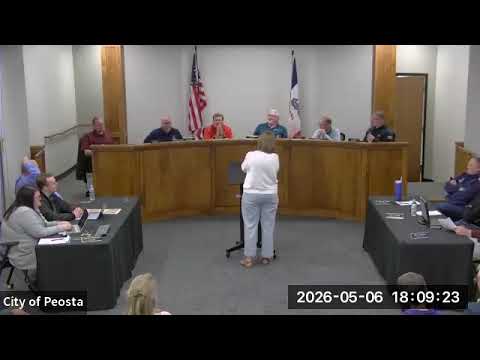
Peosta’s council and staff spent the bulk of a May work session reviewing an Iowa Department of Transportation feasibility study that lays out sharply different paths for Highway 20: a north local access road through private property that would lead the DOT to close the Cox Springs and Thunder Hills intersections, or a longer‑term half‑diamond interchange that advocates say would better serve growth and safety.
The mayor told the room the DOT has four options in its study and that the choice the city asks the DOT to pursue will shape the next five to 20 years of planning and development. “If one of those solutions is built first, they’ve got the access‑control issue out of the way and they’re less interested in helping the other project,” the mayor said, summarizing DOT staff guidance.
Why it matters: DOT inclusion would put a project into the agency’s five‑year plan and begin a multi‑year engineering and construction pipeline. Staff told the council the DOT evaluates projects for its five‑year plan in October; to be competitive, the city must present a business case and an indication of local financial participation. Staff said DOT advisers have suggested the city’s contribution should be roughly 50% to improve project scoring.
What the options would do: The local‑road alignment described in the study would run through property east of Thunder Hills and provide a new connection to the Swiss Valley interchange. Staff estimated that option at about $8 million in current dollars and said it would require developer involvement and utility work to be built as a city street. The half‑diamond interchange was estimated at roughly $16 million in current dollars and was described as a longer‑term, higher‑capacity fix; staff estimated a 15–20 year horizon under typical scheduling.
Local impacts and business concerns: Several business owners and developers asked about access for existing businesses if intersections are closed. Council members noted that closing Cox Springs and Thunder Hills without clear alternate access could isolate investments along the corridor. Staff warned that if the DOT participates in the local‑road option, they would likely close the intersections and that reopening them later would be unlikely absent construction of secondary access.
Council leaning and next steps: After discussion and a show‑of‑hands at the meeting, those present said they prefer pursuing the interchange option as the long‑term solution while continuing to plan for a local road and short‑term safety fixes. The mayor and staff said they will continue DOT coordination and prepare materials so the city can signal a preferred option and a proposed local match by late summer for the DOT’s October review.
Short‑term work: City staff noted an improvement planned this year—a deceleration lane and better lighting at Cox Springs—to reduce immediate crash risk at a known blind‑spot. Staff emphasized the deceleration lane is an interim safety measure, not a final remedy.
What’s next: Staff will draft the business case and clarify a dollar figure the city can offer as a match. The council asked staff to continue developer and county engagement around south‑connector concepts and to return with more detail about financing implications before any formal decision to commit local funds to the DOT application.