Mosquito control briefing: city outlines spray protocol, reports high trap counts and West Nile testing
Summary
Mosquito control staff described the department's ULV spray protocol and ground-application strategy, reported two surveillance trap counts (about 780 and about 2,500 mosquitoes) with a small number of Culex detected, and said specimens were sent to the state lab for West Nile testing.
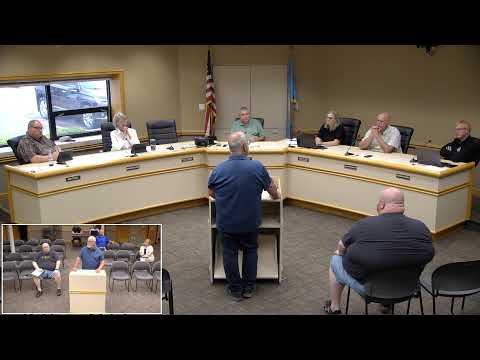
Mosquito-control lead Chad briefed the City Commission on how the department applies adulticide and on recent trap surveillance results, saying operations are driven by wind, temperature and precipitation conditions.
Chad explained the program uses an ultra-low-volume (ULV) fogging application; the transcript identifies the active ingredient as "peromethine," which staff described as the contact spray applied as a fine mist. (Public materials and product labeling identify common municipal adulticide active ingredients as permethrin or related pyrethroids; staff said the product becomes ineffective once droplets contact foliage or other surfaces.) Chad described ideal application conditions (temperatures above 50°F, wind 2–8 mph, no precipitation) and said crews typically operate from about 8 p.m. into the night to maximize mosquito activity windows.
On surveillance, Chad reported two trap counts: roughly 780 mosquitoes in one trap (five Culex detected) and roughly 2,500 mosquitoes in another (21 Culex detected). Chad said those samples will be sent to the state lab for West Nile virus testing and that results will be posted on the state website when available. "We sent those mosquitoes into the state lab and they test those mosquitoes to see if they actually are carrying the West Nile virus," he said.
The department has expanded ground-application in parks using a product with a residual (identified in the transcript as benthrin/"tempo") that lasts seven to 14 days depending on rain and irrigation. Chad and commissioners noted weather and wind can prevent effective aerial application; staff said they will continue to schedule a primary night and a backup night each week to allow for weather-related delays.
Commissioners said the city has the budget for spraying but must consider weather and community concerns about chemicals; staff said public notices are used to allow residents to protect plants if they prefer. The briefing closed with an operational commitment to continue surveillance and to apply ground or aerial treatments when conditions make them effective.
AI generated
The text on this page is AI generated. Summaries, highlights, analysis, and video transcripts are all produced from the original source material.
AI can make mistakes, so if you spot one, and we will fix it for everyone.
Note: the source content is unaltered by us. Any content source we link to, be it a video, an audio recording, or a document, is presented exactly as its publisher released it. That publisher is usually a government body, sometimes an individual official or another organisation.