Get Full Government Meeting Transcripts, Videos, & Alerts Forever!
Get email alerts on the Housing topic
No spam. Unsubscribe anytime.
Neighbors oppose two‑story duplex; BZA continues decision after split vote
Summary
The Board of Zoning Appeals heard extensive public opposition June 20 to a proposed two‑story duplex at 412 East Wy Street, citing scale, parking and safety concerns. An initial motion to approve staff‑recommended findings failed, and the board voted to continue the application to the next meeting so the full board can review possible revisions.
A proposed two‑unit duplex at 412 East Wy Street drew sustained public opposition at the Board of Zoning Appeals meeting June 20, prompting the board to continue the petition to its next hearing after an initial approval attempt failed on split vote.
Planning staff presented the petition and recommended approval, concluding the design met the UDO’s technical standards: the plan provides the maximum four parking spaces allowed for a duplex, meets impervious‑surface limits (44.5% under the 45% maximum), and satisfies setback requirements. "Staff found that the petition meets the use specific standards in the UDO," senior zoning planner Jamie Kryler said.
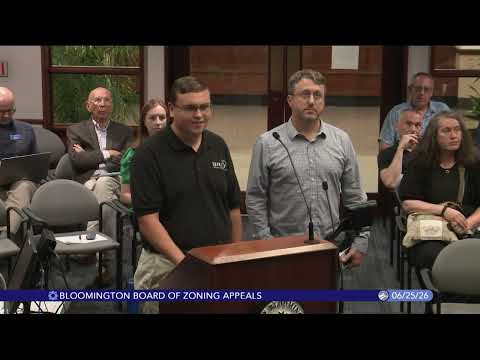
Petitioner Kevin Spicer told the board he had intentionally designed the proposal to avoid variances. "I met every requirement ... I'm not asking for any variances," Spicer said, adding the duplex includes two three‑bedroom units — the maximum allowed under UDO rules.
Multiple neighbors and neighborhood representatives urged denial, arguing the two‑story structure is incompatible with the block face of predominantly one‑story homes, will exacerbate narrow‑street parking and safety issues, and represents demolition of existing single‑family housing in favor of rental units. John Lawrence submitted an exhibit comparing the proposal to every home on the block face and urged the board to find the proposal does not meet UDO 20.03.030 B3C2 (similarity in general shape, size and design). Julie Vander Schmidt called the project a "predatory demolition" that would make owner occupancy less attainable in the neighborhood.
After deliberation, one board member moved to adopt staff findings and approve the petition; that motion failed on a roll call (Burrell yes; Fernandez no; Kinko no). Board members then moved to continue the petition so the full board could be present and to allow staff and the petitioner time to consider scaling back unit size or number of bedrooms; the continuance passed by roll call (Burrell yes; Fernandez yes; Cassino yes).
Why it matters: The hearing highlighted tensions between the city’s aim to add housing units and neighborhood efforts to protect block‑face character and pedestrian safety on narrow streets. The petition met technical UDO thresholds but drew strong objections on compatibility grounds that hinge on the board’s interpretation of the UDO’s neighborhood compatibility standard.
What’s next: The petition is continued to the next BZA meeting; the board asked the petitioner and staff to explore design adjustments and confirmed the case will return when the full board is present.