Get Full Government Meeting Transcripts, Videos, & Alerts Forever!
Get email alerts on the Patient Safety Apms topic
No spam. Unsubscribe anytime.
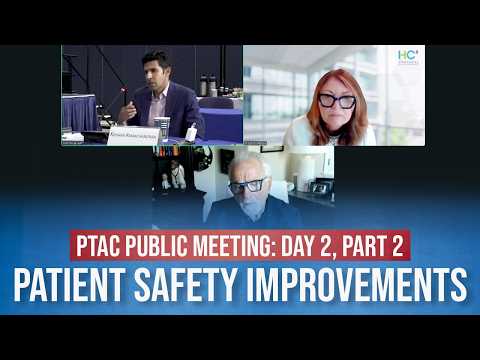
PTAC commenters and members push for stronger patient-safety requirements tied to payment models
Summary
At a public PTAC meeting, experts and committee members urged HHS to tie patient-safety infrastructure to payment policy, proposing a mix of CMS-backed mandates, incentives that fund safety capacity, stronger measurement and use of professional-certification programs. PTAC will compile recommendations for the HHS secretary.
A broad set of public commenters and members of the federal PTAC recommended that the Department of Health and Human Services use payment policy to compel faster adoption of patient-safety infrastructure nationwide.
Dr. Divi Pade, introduced during the public-comment period, told the committee that decades of system failures mean voluntary approaches have fallen short and “I think we need government intervention.” He urged PTAC to recommend that the HHS secretary pursue enforceable safety standards — potentially backed by CMS conditions of participation — and suggested creating a national patient-safety data infrastructure and public reporting of medical-claim and settlement spending to incentivize health systems to act.
The recommendation from public commenters dovetailed with committee deliberations that followed. Several members said safety should be embedded in alternative payment models (APMs) and that payment could be structured both to fund safety investments and to hold poorly performing organizations accountable. Committee member Krishna said payment models are “a way for us to align incentives to what we as a society want our care delivery systems to focus on,” and recommended starting by building safety into existing APM frameworks rather than designing entirely new programs.
Gina Hoxie, director of payment and access at the American Society of Clinical Oncology, urged PTAC and CMS to leverage existing clinician- and society-led certification programs such as ASCO Certified. “Medical specialty societies are uniquely positioned to define what safe, high-quality care looks like in practice,” she said, arguing that integrating those certifications into federal models would accelerate adoption, reduce duplicative reporting, and promote multi-payer alignment.
Speakers across the session urged a balanced approach to measurement and incentives. Dr. Patrick Romano (University of California, Davis) summarized six guiding principles, including making safety a core element of every APM, using multiple measures to avoid creating perverse incentives, and monitoring unintended effects such as underuse or gaming. Several committee members emphasized care coordination and transitions of care as high-impact domains for safety measurement.
Members debated whether requirements should be mandatory or incentive-based. Committee member Lee argued that status quo is not acceptable and suggested a graded model that sets mandatory baseline safety requirements for new APMs while offering bonus incentives for higher-performing organizations. Derek and Lauren, other committee members, stressed that culture change, workforce burden and data interoperability must be addressed; Lauren highlighted the need to capture the patient and family voice at the point of care so safety concerns can be raised without fear of reprisal.
No formal motions or votes took place during this session; the committee directed its attention to drafting recommendations. The PTAC chair (name not specified in the transcript) closed by reminding members the committee will submit a report to the HHS secretary with recommendations on targeting improvements in patient safety through APMs.
What happens next: PTAC will incorporate today’s public comments and the committee’s deliberations into its report to the Secretary of HHS. That report will be the vehicle for recommending whether HHS and CMS pursue mandatory conditions, payment incentives for infrastructure, adoption of society-led certification, enhanced measurement, or some combination of those approaches.