Get Full Government Meeting Transcripts, Videos, & Alerts Forever!
Get email alerts on the Patient Safety Payment Models topic
No spam. Unsubscribe anytime.
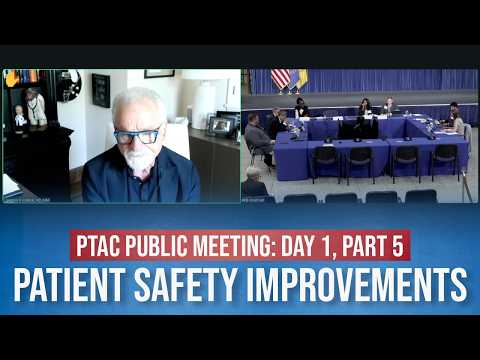
PTAC urged to embed patient safety across payment models, co-chair says
Summary
At its closing session, PTAC members debated whether to integrate patient-safety measures across CMS payment programs or to develop a distinct patient-safety model; the committee signaled support for both piloting a targeted model and adopting cross-cutting safety measures, and will report recommendations to the HHS Secretary.
Dr. Lee Mills, co-chair of the HHS Physician-Focused Payment Technical Advisory Committee (PTAC), closed the committee's day of expert presentations and deliberations by urging the group to include patient safety in its recommendations to the Secretary of Health and Human Services and by emphasizing practical next steps for payment model design.
"We now have time for the committee to reflect," Mills said as he opened the round of member comments, and later summarized the meeting's central tension: whether patient safety should be "baked in" across a range of Centers for Medicare & Medicaid Services programs or developed as a distinct patient-safety model. He said both approaches have merit and recommended the committee consider cross-cutting safety measurement concepts while also supporting pilots for a targeted safety model.
Why it matters: Committee members repeatedly cautioned that payment approaches alone have a limited track record of improving safety and that design choices could unintentionally undermine safety culture. Several participants told the committee that measurement, incentives, data infrastructure, and organizational culture must work together to make safety improvements durable.
Key takeaways from the discussion included:
- Balance integration and a pilot: Members described a trade-off between integrating patient-safety metrics into existing advanced payment models (APMs) and advocating for a separate model focused exclusively on safety. Mills said the recommendation could include both "bake in" elements across programs and support for a pilot patient-safety model.
- Data and EHR interoperability: Participants pressed for an interoperable data layer, standardized measures, and greater CMS leadership on infrastructure so safety signals can be collected and acted on across settings rather than remaining siloed in hospitals.
- Measurement and patient voice: The committee emphasized that patient-reported outcome measures (PROMs) and patient-reported experience measures (PREMs) can reveal near misses and safety signals that systems sometimes miss; members urged building those elements into reporting datasets.
- Incentives and unintended effects: Several members warned that placing large sums of money at stake can prompt gaming or risk avoidance. As Mills summarized, shared savings, withholds, or earn-backs may have promise but must be designed to reward reporting, learning, and measurable improvement rather than underreporting.
- Culture, workforce, and leadership: Multiple speakers stressed that safety depends on professionalism, transparency, psychological safety, and training, and that chief executives and compliance officers must be part of the solution because payment incentives alone cannot create safety culture.
- Technology and AI: The group highlighted opportunities to use AI and automated tools — including the automated evolution of trigger tools — to reduce reporting burden, identify risk earlier, and make safety problems more visible, but urged deliberate, incremental deployment and monitoring for AI errors.
Mills closed with two emphatic summaries from the day's discussion: that many preconditions needed to improve safety already exist, and that, in one speaker's words, "it's just a willpower issue," not primarily a funding problem. He also noted that while funding or payment may be necessary for implementation, the committee should ensure penalty structures do not make it cheaper for organizations to pay a fine than to adopt safety systems.
Next steps: PTAC will compile these findings into a report to the Secretary of Health and Human Services. The committee will reconvene tomorrow at 9:00 a.m. Eastern for an expert session on payment mechanisms and financial incentives, with a public comment period scheduled for approximately 10:50 a.m. Eastern and four public commenters signed up.
The committee's discussion contained no formal votes or adopted motions during this session; members focused on framing recommendations and identifying areas for piloting, data standardization, and stakeholder engagement.