Get Full Government Meeting Transcripts, Videos, & Alerts Forever!
Get email alerts on the Economic Development topic
No spam. Unsubscribe anytime.
Inland Port outlines $30 million innovation-district plan and seeks Carter Lake collaboration
Summary
Gary Clark of the Inland Port presented the authority's innovation-district master plan and funding under LB 164 (2024), including a $30 million allocation, a 170-unit housing goal by 2028 and local gap funds; he asked Carter Lake leaders to consider collaboration on sites, zoning and workforce opportunities.
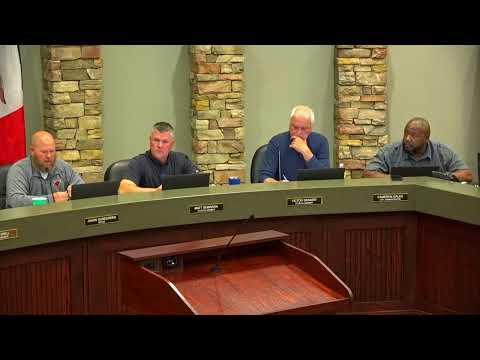
Gary Clark, a representative of the Inland Port authority, told the Carter Lake City Council the authority is pursuing an innovation district and related development projects that could overlap the city’s border and offer collaboration opportunities.
"Our efforts were developed by LB 164 from the state 2024. It required us to develop an innovation district with $30 million," Clark said while outlining a master plan and a boundary that covers roughly 3,000 acres near Carter Lake. He said the Port’s priorities also include an airport-business-park component and an overall master plan with partner organizations including MAPA and UNL.
Clark described an explicit housing goal tied to the Port’s plan: 170 residential units by 2028, of which about 20 could be single-family and 150 multifamily. He also said the authority has set up a revolving loan fund and a $300,000 gap fund to help businesses relocate or expand within the Port boundary, and that those amounts could grow with state interest earnings.
The presentation included site-level examples: an evaluation of the US Mill building (about 100,000 square feet), a contract for a former Casey’s property between 30th and 28th, acquisition of church property and contracts for old silo properties that could be re-used for a "creative housing campus" and an R&D hub. Clark cited partnerships with private firms such as Alquist 3D to explore rapid 3D-printed housing prototypes and named OEDC and Burlington Capital as partners on a recently acquired 150,000-square-foot facility on Abbott Drive.
Clark asked the council to keep lines of communication open and to consider city collaboration on zoning, workforce-development strategies, a potential truck route connected to an Enterprise Park site, and possible federal grants to study barge-and-dock freight options. "If it could benefit you all, we want to make sure that we look at that as well," Clark said, inviting staff and council to follow up.
Why it matters: Clark’s presentation links state-authorized funding (LB 164) and regional planning to development proposals adjacent to Carter Lake. The Port’s housing and loan-fund targets and the TIF-related site work described would affect land use, infrastructure demands and future tax-base decisions for the city if projects move forward.
What’s next: Council members and staff said they will review the materials, coordinate with city planning and inspection staff, and consider whether to pursue formal intergovernmental collaboration or joint workshops as site concepts are refined. Clark left contact information and the Port’s web address for follow-up.