Get Full Government Meeting Transcripts, Videos, & Alerts Forever!
Get email alerts on the Patient Safety Payment Models topic
No spam. Unsubscribe anytime.
HHS and CMS leaders tell PTAC payment models must put patient safety first
Summary
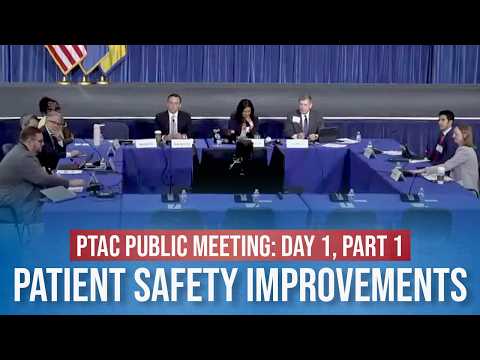
HHS Counselor Samuel Waters and CMS Innovation Center Director Abe Sutton opened PTAC's two-day session, urging payment models, better measurement and thoughtful deployment of AI to reduce preventable patient harm and to align incentives that reward improvement.
HHS Counselor Samuel Waters told members of the Physician-Focused Payment Technical Advisory Committee that patient safety must be a “North Star” for federal policy, opening a two-day discussion on how alternative payment models can reduce preventable harm.
Waters, speaking about a personal tragedy involving Brianna Bauer — who suffered lidocaine toxicity after a routine procedure and severe anoxic brain injury — said the example moved the issue beyond theory. “Stories like mine are not rare,” he said, urging a balance between accountability and a learning culture that surfaces errors rather than driving them underground.
Abe Sutton, director of the Centers for Medicare & Medicaid Services Innovation Center and deputy administrator at CMS, said patient safety is central to the Innovation Center’s three strategic pillars: evidence-based prevention, patient empowerment and choice and competition. Sutton said payment models can and should reward safety, noting examples such as lead, access and aspire models and CMS’s hospital safety programs.
“Artificial intelligence, large language models, and advanced analytics can help identify safety events hidden within millions of clinical records,” Sutton said, adding that AI also introduces risks: “Algorithms can miss critical information” and AI-enabled documentation can propagate inaccuracies.
Both leaders framed the committee’s role as technical and advisory: the meeting’s outcomes and public comments will inform a report to the Secretary of HHS. Organizers said written background materials and an environmental scan are available on the ASPE PTAC meeting page and that a public comment period will be held the following morning with three-minute oral comments for registered speakers.
PTAC co-chair Dr. Chinny Pulluru, who led the meeting, said the committee will focus on how to measure safety in value-based care, how technology can improve safety without distracting care, and how payment models can create opportunity rather than risk. The committee will use the next two days to develop recommendations to shape physician-focused payment models that center safety.