Get Full Government Meeting Transcripts, Videos, & Alerts Forever!
Get email alerts on the Patient Safety topic
No spam. Unsubscribe anytime.
Experts urge safety-science, human-factors approach to reduce patient harm
Summary
Patient-safety experts told a P-TECH panel convened by HHS that preventing harm requires system design and human-factors engineering, stronger near‑miss reporting, and specialized safety training rather than relying on clinician vigilance alone.
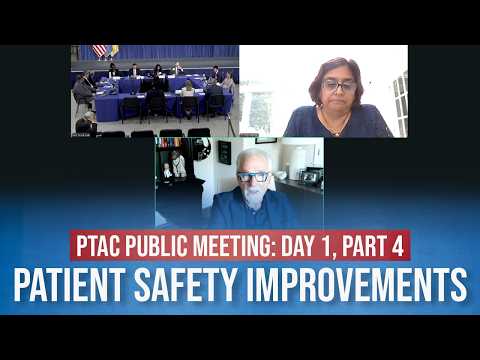
At a P-TECH expert session produced by the U.S. Department of Health and Human Services, specialists in patient safety urged federal policymakers and health systems to adopt engineering‑led, systems approaches to reduce medical harm.
Dr. Terry Fairbanks, senior vice president and chief quality and safety officer at MedStar Health, said health care must move beyond asking clinicians to be “conscientious” and instead design systems that make it hard to make dangerous errors. “We have to use hazard risk and error data. We need to understand where the near misses are,” Fairbanks said, arguing that safety requires a different skill set than traditional quality improvement.
Why it matters: Panelists warned that many adverse events are not captured by current quality metrics and therefore escape existing incentives. Fairbanks distinguished quality measures — repeatable, metric-driven process checks — from safety, which focuses on preventing harm through design and human‑factors mitigation.
Fairbanks gave concrete examples of design failures: a defibrillator whose controls allowed a clinician to accidentally power it off instead of delivering a shock, and a door with a pull handle labeled “push” that prompts the wrong action. He said labeling and admonitions are poor substitutes for engineered safeguards and urged hiring more trained safety engineers and embedding human‑factors expertise in teams.
Panelists also pressed for a culture that supports reporting. Fairbanks said leaders must create environments where frontline staff report near misses without fear of punishment so organizations can study hazards before patients are harmed. “We have to encourage reporting and study the errors before they injure a patient,” he said.
The panel discussed barriers to scaling proactive safety work. Committee members noted that current reimbursement tends to reward quality metric performance, not uncounted safety improvements, and that legal and operational barriers can impede open disclosure and learning programs. Tejal Gandhi of Press Ganey Associates and Melissa Swanfield of Meditech added that workforce training, governance, and leadership expectations are essential complements to technology.
The session concluded with committee discussion on how to scale safety practices across diverse systems and the role of federal incentives. The panel broke for questions and planned follow‑up work to translate promising pilots into broader standards and funding requests.