Get Full Government Meeting Transcripts, Videos, & Alerts Forever!
Get email alerts on the Housing topic
No spam. Unsubscribe anytime.
Housing strategy says MCI/Junction Village could supply bulk of Concord’s five‑year goals; committee raises questions
Summary
A consultant‑backed strategy paper presented June 25 estimated the MCI/Junction Village scenarios could produce hundreds of new units — including roughly 150 affordable and about 550 'attainable' units under a 900‑unit yield — but committee members pressed for clearer school‑impact analysis, firmer developer commitments and a longer build horizon.
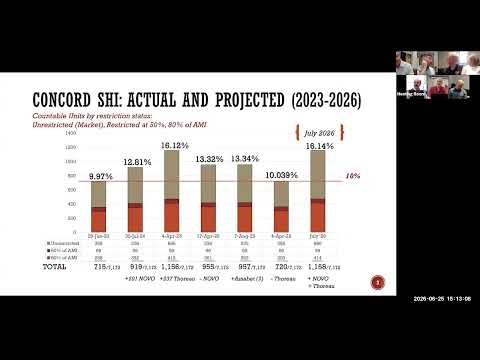
Matt Johnson, who led a housing strategy prepared with the town's housing foundation, told the MCI Master Plan Committee on June 25 that an updated, targeted approach is needed now that recent 40B projects have changed Concord’s subsidized‑housing inventory. "The MCI concrete project could help with that," Johnson said as he walked members through pro forma scenarios and occupancy assumptions.
The presentation laid out the context: high home prices, aging first‑time buyer demographics and municipal workers increasingly priced out of town. Johnson said the town’s previous housing production plan (2022) predates two new 40B developments and the sudden availability of the MCI site, so the committee needs interim, practical targets while the next production plan is developed.
Why it matters: Johnson showed a scenario in which a developer yield near 900 units at MCI, with a 20% affordability assumption, could generate roughly 150 restricted affordable units and about 550 units the presentation labeled "attainable" (a middle tier above deeply subsidized housing). Those outputs, Johnson said, would account for a large portion of the Affordable Housing Trust’s five‑year target and reduce the town’s near‑term gap in attainable housing.
Committee members did not accept the scenario at face value. Members repeatedly asked how Johnson estimated student yields per bedroom; Johnson said he used a regression analysis based on Concord’s 2010–2014 development experience and that his numbers run about 10% higher than MAPC figures. "I took our more higher numbers into the model that came out of that 2010 to 2014 period," he said in response to questions, adding that data limitations make some attainable and ownership counts approximate.
Several members warned the pace implied by the 900‑unit scenario could be disruptive. One member noted that the combined effect of the two 40B projects and a large MCI buildout could create roughly 20–25% housing growth over a multi‑year horizon, and urged a longer planning horizon or negotiated annual build limits so school and infrastructure impacts are manageable. Johnson acknowledged timing uncertainty and said negotiations with the developer and the select board remain ongoing.
A recurring theme was negotiation and feasibility: committee members said the developer (referred to in discussion as DAM/ECAM) has publicly signaled reluctance to include substantial affordable housing in initial statements, but that final terms are negotiable and must be amenable to town meeting. "It's a negotiation," a committee member said during the discussion. Johnson emphasized his role was to show feasible targets from a housing‑community perspective, not to finalize terms.
The committee asked for more robust, transparent numbers before adopting targets: refined assumptions on unit mix, clearer per‑bedroom student yield analysis, and a financial feasibility study that shows how affordability percentages affect development economics. Consultants and staff were asked to return with updated analyses at the next meeting.
Next steps: the committee set a biweekly meeting cadence and requested the consultants refine affordability scenarios, provide clearer market/rent inputs for the "attainable" category, and detail how the MCI yield and any town swap sites map onto the Affordable Housing Trust’s goals. The committee will also press for alignment between the town's negotiation strategy and MassDOT access constraints before advancing zoning recommendations.