Get Full Government Meeting Transcripts, Videos, & Alerts Forever!
Get email alerts on the Ocean Outfall topic
No spam. Unsubscribe anytime.
Falmouth board submits ocean outfall DEIR to state, opening public review
Summary
The Falmouth Select Board voted June 8 to submit the town's Draft Environmental Impact Report for a proposed ocean outfall to the Massachusetts Environmental Policy Act office, triggering a public and regulatory comment period and a July public meeting. Town staff says the outfall would reduce nitrogen loads while protecting eelgrass with construction and monitoring commitments.
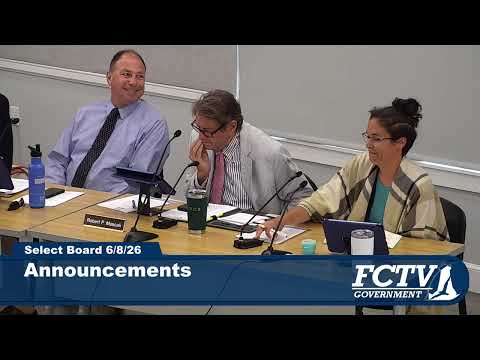
The Falmouth Select Board voted to submit the Draft Environmental Impact Report (DEIR) for the town's proposed ocean outfall to the Massachusetts Environmental Policy Act (MEPA) office, beginning a public and regulatory review period.
Amy Lo, Falmouth's wastewater superintendent, told the board the plan would replace the town's existing groundwater discharge with a pipeline and diffuser roughly 2,300 feet offshore. "We're planning to replace the town's groundwater discharge with an outfall discharge," she said, and stressed the outfall would continue tertiary treatment and ultraviolet disinfection. The conceptual design is sized for a future average annual capacity of about 3 million gallons per day; the most recent daily average flow is roughly 490,000 gallons.
Lo summarized more than two years of technical work included in the DEIR: hydrodynamic modeling, eelgrass and benthic surveys, fisheries assessment, and an anti‑degradation evaluation. The consultants found strong tidal mixing at the proposed diffuser site and projected a 101‑to‑1 dilution within a few hundred feet of the outfall. Lo also said the project is expected to enable wider sewering that would reduce nitrogen delivered to the Sound by an estimated 12,000 kilograms per year from the targeted peninsulas.
Board members pressed staff on construction timing, permitting and safeguards. Josh Wrigley, the town's coastal resilience specialist, described the Surf Drive nourishment alternative endorsed earlier by the board and explained permitting options for repeated nourishment. Regarding the outfall, Lo said the design includes time‑of‑year construction restrictions and a contingency plan for drilling fluids used in horizontal directional drilling that will minimize impacts to eelgrass. She added that the town will evaluate additional treatment measures—such as changes to dissolved oxygen or pH—before converting groundwater discharge to surface water discharge to meet state permit requirements.
Public commenters raised questions about pharmaceuticals, industrial chemicals and certainty around local currents. Craig Martin said he wanted guarantees that broader water quality would not be harmed. John Waterberry of the Water Quality Management Committee placed the DEIR in a multi‑decade context and urged board support; the Buzzards Bay Coalition also submitted a letter of support that the board received into the public record.
The board approved a motion to submit the DEIR to MEPA and directed staff to publicize the document and hold a public meeting in July. Lo told the board she expects final MEPA action later in the year and outlined subsequent permitting, state revolving fund financing and a construction schedule that could begin in the early 2030s depending on approvals.
What happens next: MEPA will open the DEIR to public and agency comment; the town plans a July public meeting to present the DEIR and receive feedback. Further permitting, financing and design work will follow before any construction contract is awarded.