Get Full Government Meeting Transcripts, Videos, & Alerts Forever!
Get email alerts on the Farm Tax Policy topic
No spam. Unsubscribe anytime.
Town assessor recommends expanding Rocky Hill’s farm tax exemption beyond dairy; committee weighs verification and zoning questions
Summary
At the April 27 subcommittee meeting, the town assessor proposed updating ordinance 223-10 and local application of Conn. Gen. Stat. §12-81m to extend 50% property-tax abatements to vegetable, nursery, vineyard and certain nontraditional farms; members pressed for reporting requirements and zoning changes to clarify greenhouse and hoop-house treatment.
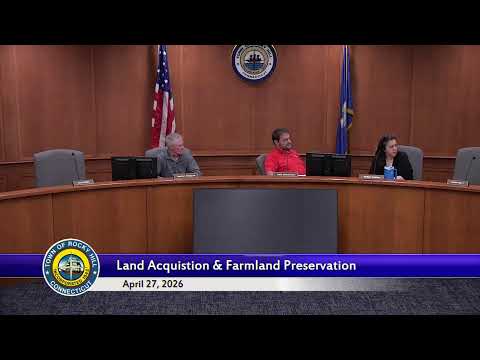
The Open Space Land Acquisition & Farmland Preservation Subcommittee on April 27 heard a proposal from the town assessor to revise local ordinance 223-10 and the town’s application of Conn. Gen. Stat. §12-81m so the 50% property-tax abatement now limited to dairy farms would also cover vegetable farms, nurseries, orchards (including vineyards) and certain nontraditional operations such as hydroponics.
"My purpose of bringing this before the committee is after reviewing some of the state statutes, bringing Rocky Hill up to a platform where we're helping the farmers," the town assessor said, presenting a memo and an analysis of town properties and exemptions.
The assessor walked members through how the state and local rules interact: land classified under PA 490 receives a substantially reduced assessment; he cited an example assessment around $418,000 for a parcel (half of that under the 50% abatement) and said the resulting additional tax liability at the current mill rate would be roughly $6,000 on the land. He also noted recently passed local changes to building and machinery exemptions, and that combining those with expanded eligibility could lower annual town tax receipts by about $20,000 at current rates, based on the figures discussed at the meeting.
Members focused on two practical issues: how the town would verify qualifying farm activity and whether new cropping methods or structures would qualify. The assessor and committee discussed requiring either an annual declaration of what is being grown or a multi-year farm management plan so a parcel is not disqualified simply because a grower leaves a field fallow for a season. "If it was in your management plan, because they didn't grow a vegetable that year and they let it grow to replace the nutrients, I would think that would be acceptable," the assessor said.
Committee members also raised how the rules would treat greenhouses and hoop houses. The assessor said hoop houses—typically temporary season-extending structures—are treated differently under statute and valuation practice, but that Rocky Hill’s zoning currently does not permit hoop houses; the zoning code may need amendment to allow agricultural hoop houses. By contrast, permanent greenhouses used year-round and classified as farm buildings would generally fall under the building exemption discussed.
The meeting also clarified an eligibility threshold used in practice: the assessor referenced a $15,000 business activity threshold that applies to qualifying agricultural enterprises under state and program rules. Members asked the assessor to return with clearer draft ordinance language that would define reporting requirements, the list of eligible farm types, and how greenhouse or hydroponic operations would be handled.
No formal vote was taken to change the ordinance at the April 27 meeting; members described the session as informational and agreed to continue drafting and discussion at a future meeting.
What's next: staff will prepare draft language addressing verification (annual form or multi-year plan), enumerate eligible farm types consistent with statute, and present zoning options for allowing agricultural hoop houses and clarifying greenhouse treatment. The committee did not adopt ordinance changes at this meeting.