Get Full Government Meeting Transcripts, Videos, & Alerts Forever!
Get email alerts on the Animal Control Funding topic
No spam. Unsubscribe anytime.
Animal Charity of Ohio asks Mahoning County for $350,000 annual contract to sustain animal-control services
Summary
Animal Charity of Ohio leaders told Mahoning County officials that rising caseloads and shrinking revenue threaten animal-control services, and they asked the county to consider an annual $350,000 contract to cover core animal-control operations while the group pursues longer-term solutions.
Jenny Bowy, board president and interim executive director of Animal Charity of Ohio, told county commissioners in a roundtable that the nonprofit's animal-control and humane services are operating without an annual county contract and that sustained public funding is now critical.
"All of our services to the county are provided without a contract or operational funding," Bowy said in the Mahoning County commissioners boardroom, and she described recent organizational changes and program expansions. She told officials the organization is operating on roughly a $1.9 million budget and is seeing increased demand: "our average daily housing count for us ... is up to 225 on a daily basis. That's up almost 19% from last year," she said.
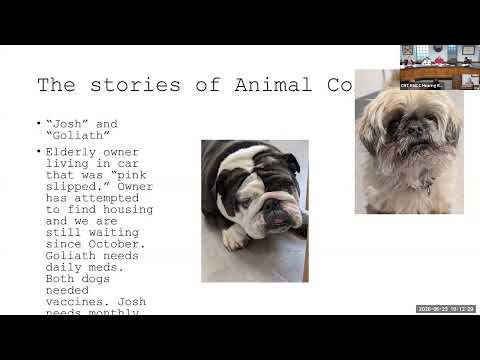
Bowy outlined the scope of work Animal Charity handles for the county: humane investigations into abuse and neglect, animal-control responses for displaced domestic and farm animals, hoarding interventions, low-cost veterinary services and community programs such as Charlie's Wish and Vets with Pets that help seniors and veterans keep their pets. She said many of those cases require extensive medical care and long stays: "the average length of stay for animals that come from animal control is 94 days," she told the room.
To cover daily care and housing costs, Bowy gave operational figures: an average daily care cost of $23.14 per animal (not including surgeries) and an estimated $156,000 in five months without surgeries. She said only about 13% of people could pay boarding fees this year and that only about 7% of animals had been returned to owners so far this year.
Facing those strains, Bowy asked the county to consider a recurring contract for animal-control services. "We're requesting respectfully an annual contract for 350,000 for animal control services for the county," she said, adding that she hoped future discussions would consider subsidizing humane services as well.
County officials and attendees discussed possible models and legal constraints under state law. Commissioners noted examples in which counties hire an animal-control officer and contract sheltering to a nonprofit; attendees also cautioned that hiring a county employee raises costs for salaries, vehicles and training. The roundtable referenced the Ohio Code as governing some duties, and staff said they would consult the county attorney about legal options and prior arrangements (including past ARPA funding used for plumbing and humane-agent salaries).
Community advocates at the meeting urged immediate and practical steps. Kiki Demovich, who runs the Charlie Senior Wish and Vets with Pets programs at Animal Charity, spoke about those programs' role in preventing pet surrenders. A resident, Alison, asked a pointed near-term question: "What's going to happen tomorrow when there's a call and the police respond and there's nobody?" Officials and charity staff said the dog warden and Animal Charity typically coordinate emergency responses, and the sheriff's office may have responsibilities for some investigations, but they acknowledged capacity limits if the nonprofit lost operational ability.
Advocates also asked for better public information. Jane Milson of Pony County Animal Advocates said local resource listings are sparse and encouraged a central county webpage or use of the 211 helpline to direct residents to pet-support services.
The commissioners did not vote on the funding request during the roundtable. County staff said they will discuss immediate steps in meetings this week and invited Animal Charity to follow up with presentations for municipal and township leaders as part of a broader outreach strategy. Bowy and attendees emphasized that funding alone is not the only solution, calling for a four-pronged approach that includes spay/neuter access, education, tougher enforcement and partnerships with local government.
The roundtable closed with a request that attendees sign a contact sheet and with county staff committing to return with more information on near-term assistance and legal options. The charity and county officials agreed to continue the conversation about sustainable funding and intergovernmental coordination.