Get Full Government Meeting Transcripts, Videos, & Alerts Forever!
Get email alerts on the Boards Commissions topic
No spam. Unsubscribe anytime.
Council debates tiered approach, supermajority waivers for volunteer board term limits
Summary
Councilors spent extensive time reworking proposed language for term limits and tenure on volunteer boards, debating whether current members should be 'reset' to a first term, whether a phased (tiered) approach should apply, and whether waivers should require a supermajority; no ordinance was adopted and the mayor will receive suggested edits.
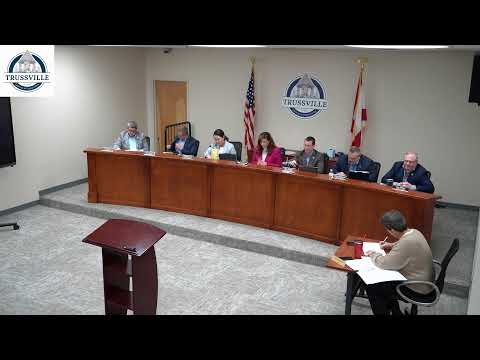
Trussville councilors opened a prolonged discussion about a proposed ordinance that would set term limits and a standardized tenure process for volunteer city boards and commissions. The session did not produce a final vote; instead councilors agreed to provide written edits to the mayor for a revised draft.
Council President Anderson objected to language that would "level set" all boards by treating current members as if they were starting a new first term. She said that approach would be unfair to long-serving members and would not reflect the different functions and authorities of boards — some have budgetary authority and binding powers, while others are advisory and benefit from continuity. "I have an issue with the provision that said that we were just going to level set all of these boards," the Council President said at the start of the discussion.
Councilor Jackson proposed a tiered phase-in as a compromise: categorize members by years of service (for example, under five years = first term; five–nine years = treated as a second term; nine-plus years = reapply) so that term limits would not immediately force abrupt turnover on boards with institutional knowledge. Jackson suggested involving peers to review classifications for ambiguous cases.
Other councilors emphasized the need to protect term limits from trivial override. One councilor recommended the ordinance include a higher voting threshold (a supermajority) to waive term limits in compelling circumstances (for example, to prevent disruption to an ongoing city or board action). "If we're going to make term limits, term limits are waived — there should be a greater bar," one councillor said, proposing more specificity around when waivers are allowed and whether a supermajority rather than a simple majority should be required.
Several councilors also noted the school board appointment process is subject to separate timing constraints: the mayor and council agreed the school-board language will likely be handled separately because of an impending vacancy that must be filled sooner than the general ordinance process will allow.
No final ordinance vote was taken. Council members asked staff to collect written recommendations and the mayor to produce another iteration of the draft incorporating tiering options and clearer standards for waiving limits.
Next steps Councilors will submit suggested language and thresholds to the mayor; the mayor will circulate a revised draft for future council consideration. The school board appointment will be treated as a separate, time-sensitive matter.