Get Full Government Meeting Transcripts, Videos, & Alerts Forever!
Get email alerts on the Forward Plan topic
No spam. Unsubscribe anytime.
Marlborough committee delays action on draft 2026 forward plan after public questions on housing, schools and data
Summary
RKG Associates presented a draft 2026 Marlborough Forward plan to the City Council Urban Affairs and Housing Committee; residents questioned student-yield assumptions and data sources, and the committee voted unanimously to postpone formal action pending further outreach and review.
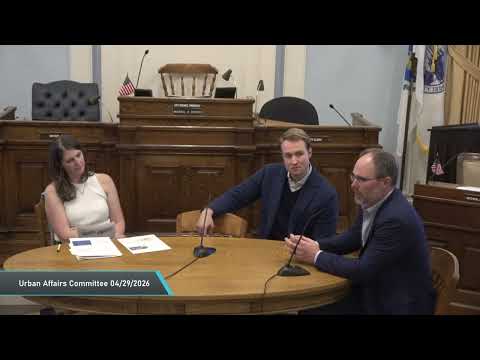
Marlborough — The City Council Urban Affairs and Housing Committee on Wednesday heard a presentation from consultants and MEDC staff on a draft 2026 Marlborough Forward plan but voted unanimously to postpone any formal action after public commenters and council members pressed for more detail on housing impacts, school enrollment assumptions and data sources.
RKG Associates’ Eric Halverson, who led the presentation, told the committee the draft frames Marlborough as a regional employment and retail hub, noting the city’s daytime population swells as roughly 33,000 nonresidents commute in for work and retail. He described sectors driving the local economy — professional, scientific and technical services, advanced manufacturing and health care — and flagged elevated office vacancy (about 17% in the consultant’s submarket measure) as an area for targeted repositioning rather than a blanket citywide approach.
“The forward plan tries to provide a roadmap for decision‑making at a citywide perspective,” Halverson said during the presentation, citing opportunities to reimagine underperforming office parcels, strengthen downtown mixed‑use areas and guide infrastructure investments alongside growth.
Why it matters: The plan lays out place‑based strategies (Donald Lynch Boulevard and the southwest quadrant were singled out) and zoning options to steer where multifamily and mixed‑use development could go. That direction has fiscal consequences for school capacity, water and sewer demand, and the city’s long‑term tax base — all issues councilors and residents pressed during the meeting.
Residents raised data and impact questions during the public‑comment period. Damon Michaels, who identified himself as a local resident, commended the report’s breadth but said some datasets seemed imprecise and urged caution on downtown height and reduced parking proposals. “RKG’s work is comprehensive, but you’ll want to refine that GIS and visitation data with your local knowledge,” Michaels said.
Steven Beo, another resident, focused on school impacts and disputed a student‑yield figure cited in the plan. He said the plan’s cited figure of 0.07 students per new multifamily unit produced results that, in his arithmetic, did not align with citywide ratios. “If you take the number of students and divide by existing housing units, you get a much higher student‑per‑unit ratio,” Beo said, arguing the plan should explicitly cite the superintendent or primary sources used to compute projected school enrollments.
Meredith (MEDC executive director) and consultants told the committee they had checked student projections with the school superintendent and had used published data sources for sales and visitation statistics (RKG cited Redfin and Placer.ai in response to questions). The presenters said they had interviewed department heads and run a fiscal‑impact model to estimate revenue and service costs tied to different development scenarios.
Councilors asked for more public outreach and said they wanted clearer, cited assumptions before adopting the plan. Several members opposed one proposal included as a discussion item — taxing multifamily housing at commercial rates — saying it would shift costs to renters and was politically fraught. Others emphasized the need to phase larger projects and to confirm water, sewer and school capacity before accelerating approvals.
Action taken: After discussion, a motion to postpone consideration of the draft plan to a future committee meeting was moved, seconded and approved unanimously. The chair said staff would coordinate follow‑up briefings and public outreach before the committee takes further action.
At a glance: key facts and figures • Target industries cited: professional, scientific and technical services; healthcare; software publishing; electronic product manufacturing; recreational industries. • Office vacancy: consultant estimate ~17% in the regional office submarket. • Selected visitation counts cited by RKG: RK Center ~4.4 million visits (non‑unique), Village District ~2.6 million, Marlborough Commons ~2.3 million (RKG cited Placer.ai as its source). • Affordable‑housing threshold: consultant noted the city’s subsidized housing inventory was above the 10% Chapter 40B threshold at approximately 10.88% (per the draft analysis).
What’s next: The committee postponed formal action to allow RKG, MEDC and staff to run targeted follow‑up sessions, to publish clearer sourcing for enrollment and visitation assumptions, and to broaden community outreach. A new meeting date will be scheduled for further review and debate.
Reporting note: Quotes and attributions in this report come from the meeting transcript and public commenters who spoke at the committee meeting on April 29, 2026.