Get Full Government Meeting Transcripts, Videos, & Alerts Forever!
Get email alerts on the Wastewater Nutrients topic
No spam. Unsubscribe anytime.
Presentation in Wareham promotes urine diversion as a tool to reduce nutrient pollution; researcher cites low crop uptake of pharmaceuticals
Summary
At a Wareham community event hosted by NOW and the Wareham Land Trust, Rich Earth Institute researcher Julia Kavichi outlined urine-diversion methods, sanitization options and multi-year studies that found pharmaceutical compounds in urine-fertilized crops at barely detectable levels, while urging care on PFAS/PAS and bio solids management.
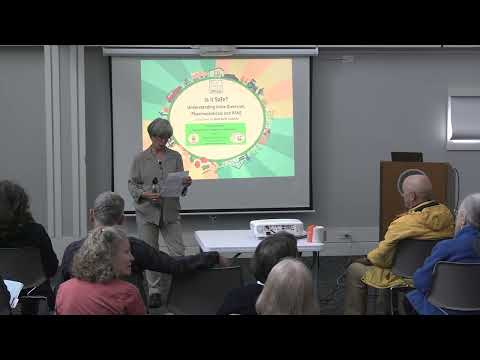
WAREHAM — Residents and conservation volunteers on [date not specified] heard a presentation on urine diversion and nutrient recycling that framed source-separated urine as a practical way to reduce nitrogen pollution entering local waterways and to reclaim nutrients for agriculture.
"We're here tonight to talk about P cycling, also known as urine diversion," said Millie, a co‑host with the community group NOW (Nutrients Out of Wareham), opening the session co‑organized with the Wareham Land Trust. The meeting drew local residents, land‑trust members and representatives from local public‑access television.
Julia Kavichi, education director at the Rich Earth Institute, described how conventional wastewater systems remove pathogens but nonetheless discharge most nutrients and a range of microcontaminants into rivers, ponds and coastal bays. "There's no such place as away," Kavichi said, summarizing the connection between household waste and downstream ecological effects.
Kavichi outlined three collection approaches used by Rich Earth Institute’s community program: portable household urine collectors that donors bring to depots, installed urine‑diverting toilets or urinals with pump‑out service, and portable toilets that collect urine separately. For community and farm applications she emphasized sanitization steps — including storage and pasteurization — and cited World Health Organization guidance that, for household garden use, urine from healthy people is generally low risk when users follow recommended wait times before harvesting raw crops.
The presentation described a multi‑year research program (in collaboration with the University of Michigan, University at Buffalo and the Hampton Roads Sanitation District) that examined the fate of pharmaceutical compounds after urine application. Using lysimeters and sampling soil, groundwater and crop tissue for lettuce and carrots, Kavichi said researchers detected compounds at "very barely detectable levels" — nanograms per gram in plant tissue and parts per trillion in groundwater — and offered exposure analogies to show those levels were tiny compared with typical dietary exposures.
Kavichi also summarized a separate University of Michigan analysis on antibiotic resistance. She said sanitized urine killed antibiotic‑resistant bacteria and that released DNA from dead bacteria did not transfer resistance genes to soil microbes in the study’s experimental conditions.
Persistent chemicals commonly known as PFAS (described in the talk as PAS) and the management of wastewater treatment bio solids were addressed as a separate concern. Kavichi said bio solids, which collect laundry and industrial household inputs, can contain higher and more variable PFAS loads than source‑separated urine and that, in the Rich Earth tests cited, urine contributed far less PFAS to soils than background levels from rain or prior land application. Still, she noted uncertainty in methods and the need for better long‑term studies and clarified that proposed Massachusetts bills (identified in the talk as S1504 and S2802) aim to regulate PFAS and to restrict land application of contaminated bio solids.
Attendees asked how to use household kits, storage volumes and regulatory constraints. Kavichi demonstrated collection funnels and containers, advised applying urine to soil (not directly to plant tissue) and recommended minimizing air exposure to prevent nitrogen loss. She also described Brightwater Tools, a Rich Earth Institute spin‑off that makes a urine pasteurizer designed to heat urine to about 80°C briefly to sanitize it.
Organizers said handouts, sample equipment and web resources — including the Rich Earth Summit site — are available for people who want more detail, and they announced a follow‑up presentation on home‑garden application scheduled for June 9. The Wareham Land Trust also promoted its June 5 anniversary gala and asked attendees to sign up for tours and email updates.
The session closed without formal votes or municipal action; organizers said video of the presentation will be shared and encouraged participants to follow up with local health and plumbing authorities before starting larger household or community collection programs.