Get Full Government Meeting Transcripts, Videos, & Alerts Forever!
Get email alerts on the Housing Finance topic
No spam. Unsubscribe anytime.
State financing, vouchers and preservation tools outlined for Mashpee housing efforts
Summary
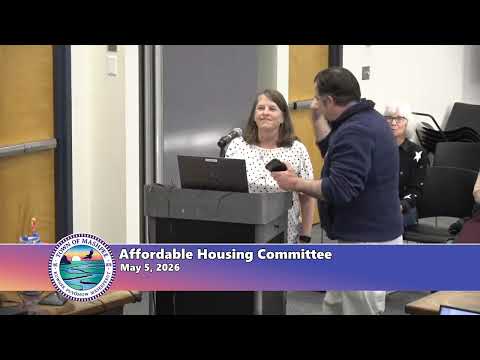
At the May meeting the Affordable Housing Committee heard from Laura Shufeld of the Massachusetts Housing Partnership about how state agencies, tax credits, vouchers and preservation programs can support local affordable housing, including constraints on project size and limits on local preference.
The Mashpee Affordable Housing Committee heard a detailed briefing on state roles in affordable housing from Laura Shufeld, senior adviser and real estate development director at the Massachusetts Housing Partnership.
Shufeld told the committee the state funds and programs split broadly into private housing production (developer financing including Low-Income Housing Tax Credits encoded in the Qualified Allocation Plan) and public housing/rental assistance (local housing authorities and the Massachusetts Rental Voucher Program). “I'm here tonight to talk about the state's role in affordable housing,” she said, and walked members through how those pieces interact with local efforts.
Why it matters: the committee is preparing to use state tools and potential town-owned sites to create affordable units. Shufeld warned that many state subsidies have minimum practical project sizes and per-unit limits that affect what the town can realistically build. “The QAP for low-income housing tax credits has a minimum number of units of 20,” she said, but added that “realistically the minimum number is closer to 35 to 40” because of fixed costs and syndication economics.
Key details members heard: - Tax-credit scale: Shufeld said smaller projects struggle to access LIHTC equity; the QAP sets a statutory minimum but the economics push practical minimums higher. She gave an example: projects of 40 units or fewer can receive up to about $4 million in tax-credit allocation in current practice. - State subsidy caps: many state soft-debt subsidies are commonly on the order of $100,000 per unit, with limited flexibility to close gaps when costs rise; Shufeld noted typical per-unit development costs in the region are far higher than those subsidy levels. - Rental assistance: the Massachusetts Rental Voucher Program (MRVP) includes tenant-based and project-based vouchers; project-based vouchers remain attached to units and do not travel with tenants. - Public housing and preservation: Massachusetts is one of a small number of states with state-aided public housing (Shufeld cited about 41,500 state-aided units) and faces a large backlog of preservation and repair needs; MHP and CEDAC participate in preservation work, including the 40T policy to preserve expiring affordability restrictions. - Local preference: Shufeld explained the rules for local preference in subsidized projects. Local preference may not exceed 70% of units and must include four categories (current residents, municipal employees, employees of local businesses, and households with children attending local schools); a municipality must justify local preference in a subsidizing agency's affirmative fair housing marketing plan.
Committee members asked how these rules apply to smaller towns and town-owned parcels. Shufeld explained programs that help municipalities test site feasibility (forgivable site-assessment loans) and assist with procurement and RFPs when public land is offered for development. On title defects and other legal barriers she said outcomes depend on the specific problem and legal remedy—sometimes a taking or other conveyance clears title, other times remediation or legal work is required.
Shufeld closed with contact information and an offer to assist local staff in navigating program applications. She also reminded the committee that some programs are geared toward larger-scale projects; the town may need to combine approaches (public land, subsidies, and smaller local tools) to meet local needs.
The committee did not take formal action on any single funding application during the presentation; members requested follow-up materials and contact points to evaluate specific town parcels and next steps for aligning Mashpee's priorities with state resources.