Get Full Government Meeting Transcripts, Videos, & Alerts Forever!
Get email alerts on the Pdlc 1050 topic
No spam. Unsubscribe anytime.
OGP tells House Labor Committee it cannot endorse PDLC 1050 without fiscal data
Summary
The Office of Management and Budget told the House Labor and Labor Relations Committee that PDLC 1050 — a bill to create a part‑time employment program across government — lacks the data needed to quantify fiscal impact; OGP presented illustrative cost scenarios and urged interagency input before the committee acts.
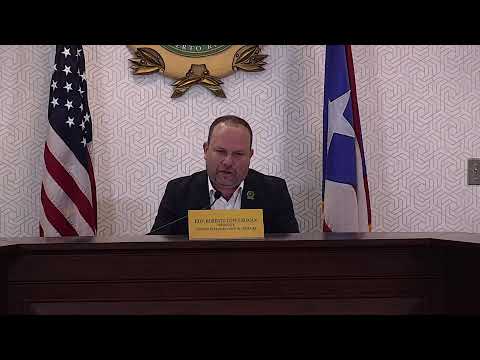
The Labor and Labor Relations Committee of the House of Representatives met June 23 to hear testimony on PDLC 1050, a bill that would establish a part‑time employment program in the Puerto Rico government. The Office of Management and Budget (OGP) presented its analysis and said it could not endorse the measure because the fiscal impact is indeterminate.
Carmen Guillén González of the OGP, presenting the agency memorial, said the bill seeks to "ampliar las oportunidades de empleo y promover alternativas que faciliten la participación en el servicio público," but emphasized that the agency must assess administrative, budgetary and operational viability before supporting the proposal. Guillén noted the bill contains no specific appropriation and that article 8 appears to rely on agencies "redistribuir sus recursos internos" to implement the program without identifying parameters or a financing source.
OGP officials said the lack of concrete data on how many positions would be created or converted, and the absence of defined implementation rules, prevents a reliable fiscal estimate. "En esta etapa ... la OGP no puede avalar el PDLC 1050, ya que la ausencia de información cuantificable no nos pone en posición para ello," Guillén told the committee.
Dr. Osvaldo Guzmán López (OGP) walked members through illustrative scenarios based on the agency's payroll assumptions. Using an approximate base cited during the hearing of about 93,000 active central‑government employees, he said a 1% adoption rate would imply roughly 930 part‑time posts (an illustrative minimum annual cost of about $26.3 million); 2.5% would be about 2,326 posts (~$65.7 million); and 5% about 4,652 posts (~$131.4 million). Guzmán emphasized these figures are hypothetical and depend on assumptions about hours, benefits and employer payroll costs.
OGP also highlighted legal and precedent concerns. The presentation cited Law 379 (May 15, 1948) and the Law of Labor Transformation and Flexibility (Law 4 of 2017), noting those statutes’ limited applicability to government employees absent explicit legislative direction, and referenced Law 41 of 2022 and prior reforms that drew scrutiny from the fiscal oversight board. Guillén said prior court scrutiny under PROMESA has led to questioning when a fiscal estimate is missing; she referred to a judge (Taylor Sin) who has criticized the government for not providing such estimates in past matters.
Committee members pressed OGP on whether the bill creates new positions or would allow substitution of incumbents. OGP officials said the measure, as drafted, reads like it would create eligible part‑time positions rather than permit direct substitution, and that substitution vs. net creation materially alters fiscal outcomes. The agency asked the Office of Human Resources (OTRH) and the Department of Labor for historical data to refine projections and to help determine whether an amendment allowing substitution could achieve the bill’s objectives with a different fiscal footprint.
OGP warned that, without identified funding sources or implementation parameters, the initiative could require widespread budget reprogramming across agencies and might prompt concerns from the Financial Oversight and Management Board about "neutralidad fiscal" in the fiscal plan. OGP recommended consulting the Association and Federation of Mayors because the bill extends to municipalities and could carry additional administrative and fiscal implications at the local level.
The committee did not take a vote. Members asked OGP to submit a supplemental memo after OTRH and the Department of Labor provide requested data; the chair closed the hearing at 9:37 a.m. with no formal action on PDLC 1050.