Get Full Government Meeting Transcripts, Videos, & Alerts Forever!
Get email alerts on the Infrastructure Bridges topic
No spam. Unsubscribe anytime.
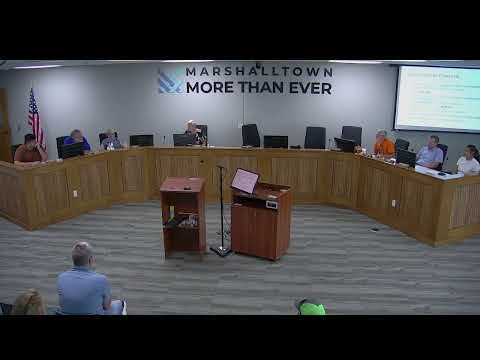
Marshalltown council delays vote on viaduct fence change order after safety, cost and design debate
Summary
The Marshalltown City Council on July 1 postponed a decision on a $109,050 change order to replace the Center Street Viaduct railing with chain-link fencing, voting 4-3 to delay until July 13 after questions about safety, vendor deadlines, costs and downtown aesthetics.
The Marshalltown City Council on July 1 postponed a vote on a $109,050 change order to replace the Center Street Viaduct railing with chain-link fencing, voting 4-3 to delay a final decision until the council's July 13 meeting.
City staff and the contractor said the chain-link option was being recommended to meet Union Pacific and Iowa DOT requirements for fencing over and near the railroad; staff said the proposal included a $109,050 change order tied to removing painting work and adding new fencing. The contractor, Luke of Boulder Contracting, warned that pausing the order could add time and cost because suppliers were holding production and pricing and the firm had requested 15 additional working days for the overall contract after previous change orders.
The vote came after more than an hour of technical briefing, council questions and public comment. A city staff member reviewed the rehabilitation scope — concrete repairs, bridge-deck overlay and fence work on a structure originally built in 1951 — and said the city had received a material quote for roughly $145,000 (for standard panels) but expected a higher installed cost (staff cited an estimated comparable figure near $399,000 for a like-for-like replacement in DOT-compliant sizes). Staff also noted the $109,050 change-order figure included savings of about $290,000 from removing sandblasting and painting of the existing rail from the current contract but did not include potential railroad-required protections or flagger costs.
Council members pressed staff and the contractor on technical points. One asked whether the city had performed ultrasonic testing to measure the remaining thickness of the existing rail; staff said no ultrasonic testing had been done. Contractor Luke said much of the additional work was jackhammering and other labor-intensive repairs and that the fence install would be on the project's critical path. "We requested additional days for the additional work," Luke said, adding the contractor had asked for about 15 extra working days.
Multiple council members and members of the public focused on the bridge's role as a downtown gateway and on appearance. Resident Heidi DeWolle asked why a special meeting had been called and whether the council could pause to explore decorative alternatives or community funding for embellishments. The staff response was that the supplier had asked for a July 1 direction to hold production and pricing and that pausing could delay manufacture and push back the schedule.
Public commenter John Herndon criticized the process and argued the city had not provided sufficient engineering data or community engagement before moving toward chain link. "I'm in utter shock to witness how we've gotten to this point," Herndon said, urging the council not to rush a permanent aesthetic decision and to involve local design resources.
Other council members countered that the unknown condition of the existing railing created safety and schedule risks. One council member said sandblasting the existing rail could reveal thinner metal and make the structure unsafe if the council delayed too long, and that leaving the viaduct closed longer would further disrupt downtown access. That view pushed some members to favor approving the chain-link change order now and adding decorative elements later so the roadway could reopen sooner.
A motion to postpone the decision until the next regular meeting (July 13) was offered and seconded and carried on a roll-call vote: Cahill — yes; Fonseca — yes; Mitchell — no; Nichols — no; Schneider — yes; Thompson — no; Yapez Gomez — yes. The council adjourned with staff directed to return with additional options and cost information for decorative alternatives and with the July 1 supplier deadline noted as a scheduling risk.
The council did not approve the change order at the special meeting; the issue will return to the council agenda on July 13.