Get Full Government Meeting Transcripts, Videos, & Alerts Forever!
Get email alerts on the Housing Finance topic
No spam. Unsubscribe anytime.
How housing tax credits, loans and local subsidies combine to finance affordable projects
Summary
WEDA described how 9% and 4% tax credits, municipal TIF, AHP subsidies, USDA and a 2023 legislative loan program combine to build mixed‑income and workforce housing in Wisconsin, illustrated with Green Bay, Madison and Darlington case studies.
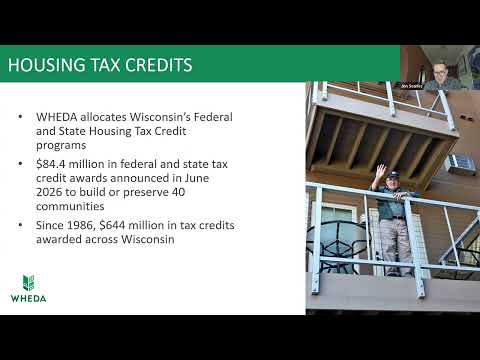
WEDA’s presentation to Shorewood officials outlined the typical financing stack for affordable housing: tax credit equity (9% or 4%), tax‑exempt bond‑paired credits, local subsidies such as TIF or ARPA, Federal Home Loan Bank subsidies, and complementary WEDA loans or state legislative loan programs.
John Surles said tax credit equity often comprises roughly 45–60% of a project’s capital stack, with loans and grants filling the remainder. He described the federal 9% credit as the most competitive source of equity and the federal 4% program as a more certain but typically lower‑equity option; Wisconsin’s state 4% program can be paired with federal 4% awards to produce equity levels comparable to 9% allocations.
Surles illustrated the mix with three case studies: a Green Bay infill development by Gorman and Company that combined a 9% award with a TIF/ARPA subsidy, a $2 million AHP subsidy from the Federal Home Loan Bank of Chicago and a WEDA permanent loan; The Ella in Madison, a redevelopment with community‑centered design and ground‑floor commercial space; and a Darlington workforce townhome project that used a USDA 514 loan and an annual tax credit allocation (described as roughly $4 million in tax credit value) to support construction for agricultural workers.
Surles also described recent state action to increase financing capacity: a 2023 legislative loan allocation of $525 million that WEDA is lending at low rates (Surles said WEDA was lending at a 0% rate in some instances) to support both tax credit and non‑tax credit deals. He framed these legislative loans as an important tool to reduce borrowing costs and expand feasibility for projects that also rely on local subsidies and private capital.
Why it matters: presenters said the diversity of financing tools—tax credit equity, local TIF money, AHP subsidy and low‑cost legislative loans—enables projects that mix market‑rate, voucher and supportive units, and that municipalities play an active role in shaping both the site selection and subsidy mix needed to make deals pencil out.
Surles invited questions and encouraged municipalities and community leaders to participate in the QAP listening process so local priorities are reflected in WEDA scoring and awards.