Get Full Government Meeting Transcripts, Videos, & Alerts Forever!
Get email alerts on the Housing Tax Credits topic
No spam. Unsubscribe anytime.
WEDA explains housing tax credits and how they relate to Shorewood’s recent award
Summary
At a Village of Shorewood presentation, WEDA outlined how federal, state and WEDA tax credits generate private equity for affordable housing, maintain affordability for 30 years, and why a nearby Shorewood property sale remains contingent on those credits and additional approvals.
John Surles, WEDA’s community and economic development director, laid out how the housing tax credit program channels private investment into affordable housing and why the Village of Shorewood recently invited WEDA to explain the process.
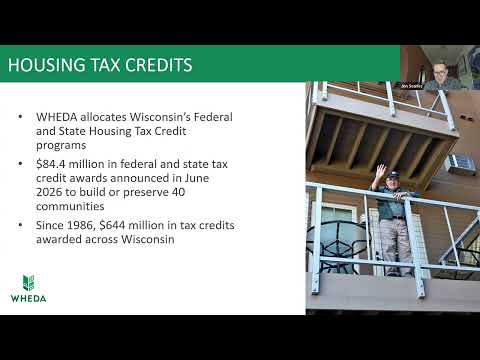
Surles said the program—created in 1986—was designed to mobilize private equity because the private market alone does not produce enough affordable housing. “The housing tax credit is responsible for building and preserving nearly all affordable housing in the country,” Surles said, adding that WEDA enforces long‑term affordability in Wisconsin by maintaining a 30‑year compliance period for projects it supports.
Why it matters: tax credits allow developers to convert a future stream of federal tax benefits into up‑front equity by selling what Surles described as a “tax coupon” to private investors. That equity lowers the developer’s debt burden and in turn reduces the rents required to operate a project, making more homes affordable than would otherwise be practical.
At the Shorewood session, Bart Grieentrog, the village’s planning and development director, said the village had solicited proposals and that Spurl Commercial LLC was announced June 3, 2026 as the recipient of tax credits for a 19‑unit project at 4448–4450 North Oakland Avenue. Grieentrog cautioned that the village’s sale of the site is contingent on the developer securing WEDA tax credits and on obtaining additional funding and an approved development agreement from the village.
Surles explained the main program types: the federal competitive 9% credit (which typically brings the most equity) and the federal 4% credit (paired with tax‑exempt bond volume and generally less equity but more certainty). Wisconsin also operates a state 4% program that can be combined with the federal 4% award; Surles said WEDA had about $7 million available in the state 4% round at the time of the presentation.
Surles emphasized how projects are evaluated under WEDA’s Qualified Allocation Plan (QAP), and said local feedback—channeled through staff such as Maria Watts, who covers Shorewood—helps shape the QAP and scoring priorities. He advised developers to review the QAP carefully because it guides award decisions.
Looking ahead: Grieentrog said village staff and WEDA would accept follow‑up questions by email and that the recorded presentation will be posted on the Village of Shorewood educational series page. The sale of the Shorewood site remains conditional on the developer finalizing funding and a development agreement.