Get Full Government Meeting Transcripts, Videos, & Alerts Forever!
Get email alerts on the Land Use Master Plan topic
No spam. Unsubscribe anytime.
Experts tell West Goshen supervisors master plan meets ordinance at a high level; residents press traffic, sewer and pedestrian safety concerns
Summary
At a June 30 continuation of a conditional‑use hearing on Westchester University’s campus master plan, planning and traffic consultants said the submission meets master‑plan ordinance requirements at the planning level but residents pressed for earlier, site‑specific traffic and sewer capacity studies; the board continued the hearing to Aug. 24, 2026.
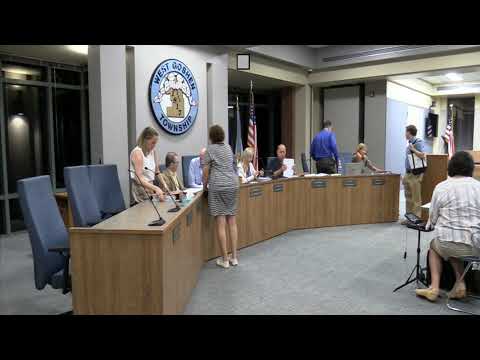
West Goshen Township supervisors resumed a conditional‑use hearing on June 30 for Westchester University’s campus master plan, hearing testimony from township and university consultants about mobility, parking, stormwater and utility capacity and taking extensive public comment on neighborhood traffic and construction impacts.
Township planning consultant Danielle Bayer of Urban Engineers, accepted as an expert, summarized her February 17 review letter. She flagged typographical inconsistencies across submitted documents, supported the master plan’s multimodal objectives and recommended safety improvements along the South New Street corridor, including consideration of a rectangular rapid‑flashing beacon (RRFB) at the stadium crossing if pedestrian traffic warrants it. Bayer said closing Church Street to vehicles would have multiple downstream effects — on SEPTA and Chesco Connect stops, food‑truck locations, borough‑owned curb space and parking — and should only be pursued after detailed study and interjurisdictional coordination.
“The plan supports improving the South New Street connection and we support looking at a bike lane,” Bayer testified, adding that rights, parking and maintenance access mean a full closure of Church Street “isn’t as simple as canceling the roadway on a map.”
University traffic consultant Guy D. Martino of Traffic Planning & Design described a master‑plan transportation analysis that evaluated 25 intersections across West Goshen, neighboring Westchester Borough and East Bradford Township. Using standard PennDOT regional growth factors together with the university’s enrollment projections, his team projected 2040 conditions and concluded that the studied intersections would operate at level‑of‑service C or better under the planning‑level scenario.
Martino also summarized a parking study based on ordinance‑required count windows. He said the north‑campus off‑street inventory, after accounting for removed modular lots and using the borough’s more conservative 85% credit, left a net 443 creditable off‑street spaces; the study concluded campuswide supply would meet projected demand, including more than 1,000 off‑street spaces on the south campus.
Several residents and nearby property owners disputed whether a planning‑level analysis is sufficient for neighborhood‑sensitive intersections. Public commenters including Sabina Strapman and Dan Schatz urged more targeted study of Norfolk Avenue, Rosland and other local cut‑throughs and asked whether the university’s phased addition of about 220 beds on the south campus would materially worsen queuing at the Rosedale/New Street intersection.
Martino acknowledged that the study combined regional (PennDOT) growth factors and enrollment projections in its 2040 scenario and said that while the master‑plan analysis is standard for a campus plan, specific land‑development applications will trigger more detailed, site‑specific traffic and parking studies and recommendations.
On utilities, Bayer said the conceptual stormwater plan appears to show sufficient space at this planning stage but cautioned that detailed runoff calculations, sewer and water capacity analyses and any separation of geothermal‑well locations from stormwater facilities must be resolved during land‑development review. She emphasized that definitive proof of adequate sewer and water capacity typically is provided at the land‑development stage when building footprints and exact bed counts are known.
Residents raised the noise record from past geothermal well construction and asked the board to ensure notice and mitigation. A township representative noted an existing binding condition tied to a prior pump‑house approval that requires notification to neighbors for some work.
Township traffic reviewer Paul Archable (Urban Engineers) echoed the need to study Church Street impacts, monitor the Rosedale/High Street pedestrian conflicts and agreed the master‑plan transportation and parking studies are appropriate for a planning‑level review but should be followed by targeted land‑development analyses as projects are proposed.
The supervisors did not vote on the master plan at the June 30 session. They agreed to continue the hearing to Monday, Aug. 24, 2026 at 6 p.m. to hear remaining witnesses (including the university’s Mr. Tally) and any additional party testimony, and they asked parties to be prepared to present evidence that evening.