Get Full Government Meeting Transcripts, Videos, & Alerts Forever!
Get email alerts on the Supply Side Health Policy topic
No spam. Unsubscribe anytime.
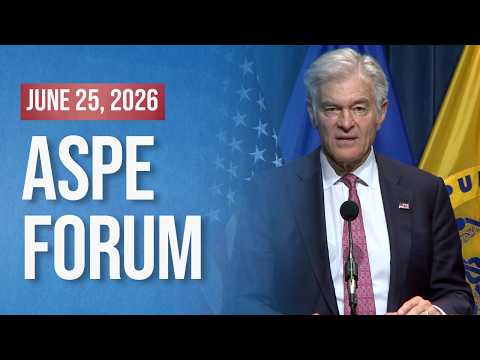
Affordability czar Casey Mulligan lays out "supply-side" health policy: patients, caregivers and competition
Summary
At ASPE's forum, Casey Mulligan argued for a supply-side approach that treats patients, caregivers, clinicians and business models as productive inputs, highlighted unpaid care valuation and adherence gaps, and urged regulatory and payment changes to expand effective supply and innovation.
Casey Mulligan, described at the session as the administration's "affordability czar," presented a supply-side framework for health policy that reframes the problem from "who pays" to "who supplies" the attention, labor, information and innovation that produce health. "Health is not the same as health care, and healthcare is not the same as health insurance," he said, stressing that the endpoint is better health, not payment mechanisms.
Mulligan emphasized patients and families as an unmeasured but essential input: education, routines and adherence influence outcomes and the productivity of clinical care. He cited a review finding diabetes self-management programs reduced HbA1c by about 0.61 points and said medication adherence for chronic disease in developed countries averages about 50 percent. "Patients and families combine general evidence with circumstances that Washington cannot observe," he said.
The presentation quantified unpaid care: Mulligan said ASPE estimates an average lifetime value of unpaid long-term care for recent cohorts at about $107,000 and described companion and travel demands that add to the system's hidden costs. He also said unpaid-care time across outpatient visits equates to roughly 207 million 40-hour work weeks annually, underscoring family-borne time costs.
On workforce and organization, Mulligan broke clinician capacity into margins—training slots, permission to practice (licensing and scope of practice), and administrative burdens—and warned that uniform regulation and payment rules can push clinicians into larger systems and reduce local experimentation. He cited the Regulatory Flexibility Act as reflecting the legal recognition that one-size rules can have disproportionate effects across different-sized providers.
Mulligan discussed technology and innovation, noting that AI and wearables are already used by patients (he cited 32 percent of adults using AI chatbots for health information and about one-third of Americans using wearables). He recounted a widely discussed forecast that AI would replace radiologists but said, in practice, AI complemented clinicians and increased imaging demand and residency slots.
Mulligan closed with a practical test: a policy is "supply-side" if it expands patient and caregiver capability, clinician capacity, entry and business innovation, data access and transparent disagreement; it is "anti-supply" if it suppresses information, blocks entry, freezes prices without regard to supply response, or substitutes centralized control for local knowledge.
The forum continued with audience questions from pharmacists, researchers and students, and ended with closing remarks from ASPE.