Get Full Government Meeting Transcripts, Videos, & Alerts Forever!
Get email alerts on the Development Litigation topic
No spam. Unsubscribe anytime.
Council declines closed briefing on Lonesome Development dispute, defers funding and engineering resolutions
Summary
The Abita Springs council voted against moving into an executive session requested for a litigation update about the Lonesome Development project, then deferred two resolutions that would explore funding options and consideration of alternative engineering opinions. A developer lawyer warned the council that failure to supply utilities as required by a final judgment could trigger contempt proceedings.
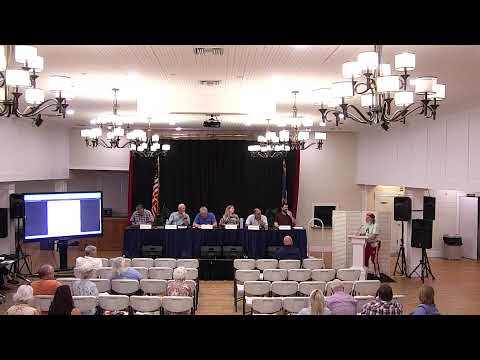
The Abita Springs town council voted down a motion to enter an executive session to receive privileged legal advice on the Lonesome Development dispute and instead deferred two resolutions that would have launched funding and engineering-review steps.
Town attorney Andrew Capotelli had asked the council for a closed session to update members on recent developments tied to Lonesome Development LLC — including a July 1 demand letter and a lawsuit the developer filed against the town engineer. He described the meeting as informational and privileged and said no vote was planned in the closed session. The motion to go into executive session failed on a 3–2 roll call (Alderman Patterson, Alderman Contos and Alderman Tom voted yes; Alderman Budro and Alderman Sauy voted no), short of the two-thirds threshold cited by the attorney for that type of confidential briefing.
At the public microphone, Martin Landrew, an attorney identifying himself as counsel for Lonesome Development, told the council the developer believes a ‘‘final and nonappealable judgment’’ requires the town to provide sewer and gas to the project as written in the development agreement. ‘‘The final and unappealable judgment requires strict compliance with the wording of the development agreement,’’ Landrew said, and added that failure to comply could lead to contempt proceedings, including ‘‘the jailing of the mayor.’’ He declined to take questions on the record.
Council members and residents then debated two resolutions on the agenda. Resolution 2025-07-01 would have authorized the town to explore voter-approved funding mechanisms (for example a dedicated millage or sales-tax measure) to pay for infrastructure options the town engineer had identified; the staff summary cited two earlier-engineered alternatives with capital-cost estimates of roughly $2 million (option one) and $1.5 million (option two), each with a 10–15 month completion schedule. Resolution 2025-07-02 would have signaled the council’s willingness to give ‘‘serious consideration’’ to a different licensed professional engineer’s opinion — including one the developer might provide — that contradicted the town engineer’s conclusions.
Opponents said the documents were provided too late for careful review, warned a tax measure could impose a large burden on residents, and questioned whether the developer had shown good faith in prior negotiations. Supporters said an affirmative resolution would demonstrate the town’s intent to act in good faith and to seek safe, cost-effective alternatives.
After extended public comment and council debate, members moved to defer both resolutions to the next meeting (or a special meeting) so aldermen could submit suggested edits to the administration within a week and receive more time to review the proposals. The mayor and staff said the developer is proceeding through planning and zoning toward final plat approval, creating a time-sensitive window for whatever solution the council adopts.
Next steps: Both resolutions were deferred to allow redrafting and further consideration; council members were asked to submit edits to administration within one week so revised language can be posted for the next regular meeting.