Get Full Government Meeting Transcripts, Videos, & Alerts Forever!
Get email alerts on the Capag Qanda Equity topic
No spam. Unsubscribe anytime.
Advisory group raises equity, data and trade‑off concerns after presentation on heat and flooding
Summary
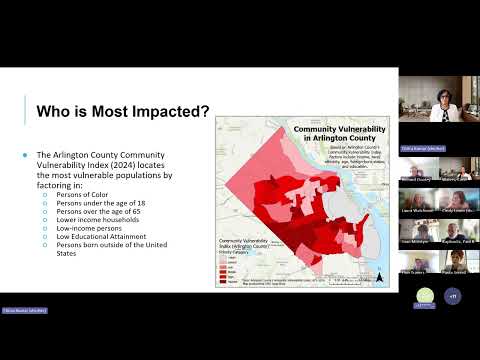
Advisory members pressed the presenter on neighborhood energy‑burden data, heat‑island measurement, redevelopment impacts on tree canopy and how to keep climate solutions affordable for vulnerable residents; several urged pre‑engaging affected communities and prioritizing benefits for frontline neighborhoods.
Members of Arlington’s Climate Action Plan advisory group used the Q&A after the Chitrakumar presentation to press for more neighborhood‑level data and to raise tradeoffs for tree canopy, redevelopment and affordability.
Joan McIntyre asked what neighborhood‑level energy‑burden data are available and whether the presenter had disaggregated findings to guide policy. Chitra replied that federal DOE tools exist but are typically coarse (tract level) and that localized fine‑grain sources would be needed to target interventions; she said a DOE tract‑level tool showed highest percentages in the 3–4% range but cautioned that can understate local burden without county‑level disaggregation.
Several participants pressed the county to pre‑engage organizations that represent vulnerable neighborhoods. Elizabeth recommended reaching out to community organizations before releasing a public comment period so voices with barriers to participation are not crowded out; others echoed prioritizing benefits for nonprofits, seniors, renters and households with below‑grade units.
Multiple members described local constraints and tradeoffs. Emily and others said dense redevelopment sometimes removes mature canopy and may increase runoff without strict engineered stormwater mitigation; Paul and others advocated shaded park infrastructure and expanded spray grounds for children, while some warned about spray‑ground impacts to tree roots and root zones. Participants also flagged concerns about large data‑center energy demand and how regional growth patterns can offset local emissions gains.
On affordability, participants pointed to past local programs (an e‑bike voucher program and low‑income discounts for bike share) as models to expand, and suggested public‑private partnerships, energy‑service contracts, community solar and cooperative models to deploy upgrades without burdening vulnerable households. Multiple speakers urged that subsidies and first‑offer benefits go to those most in need rather than to households already able to pay.
Moderator Rich closed by reminding the group to submit written comments by the end of the week and announcing AECOM’s deeper hazard presentation on July 30. Advisory members said they would continue pressing for neighborhood data, equity‑first outreach and solutions that preserve canopy while addressing housing and stormwater needs.