Get Full Government Meeting Transcripts, Videos, & Alerts Forever!
Get email alerts on the Climate Vulnerability And Equity topic
No spam. Unsubscribe anytime.
Chitra (Chitrakumar) urges Arlington to pair heat, flood and tree‑canopy investments with equity-focused policies
Summary
Climate equity consultant Chitrakumar told Arlington’s CAP advisory group that spatial vulnerability data show concentrated heat and flood risk in South Arlington and Columbia Pike, and recommended targeted tree‑planting, stormwater funding, worker protections and zoning reforms to protect vulnerable households.
Chitrakumar (Chitra), founder of CK Advisory and a former director at the Union of Concerned Scientists and U.S. EPA, told Arlington’s CAP Advisory Group that the county should pair greenhouse‑gas reductions with near‑term investments to protect the most vulnerable residents from extreme heat, flooding and related health impacts.
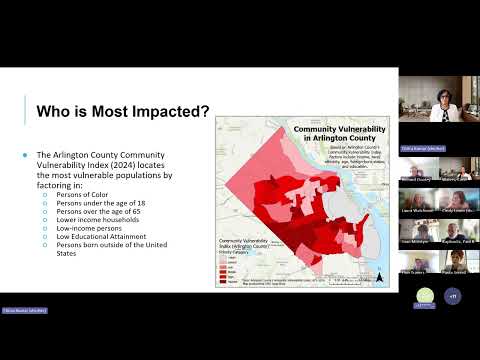
Chitra opened by defining environmental justice as “the fair and equal treatment of all people” in environmental laws and programs and said Arlington’s locally produced vulnerability index highlights South Arlington, Columbia Pike, Leewood, Waverly Hills and Rosland as higher‑risk neighborhoods. She said those areas repeatedly appear on heat‑island and social‑vulnerability maps the county has used.
The presentation flagged three near‑term policy priorities. First, prepare for more extreme heat: Chitra summarized modeling that shows days of extreme heat could roughly double by 2050 (from roughly 36 days now to an estimated 55–75 days), with the greatest risk to outdoor workers, transit riders and residents in poorly insulated multifamily housing. She recommended training, cooling access and preparatory guidance for employers and staff while jurisdictions await statewide worker‑safety standards (she cited HB 1092 and SB 288, which direct regulators to develop heat protections by May 1, 2028).
Second, protect and expand tree canopy with equity in mind. Arlington’s tree canopy was described as about 35% in 2023 toward a 40% 2035 goal, but Chitra noted large disparities: underserved neighborhoods reported canopy as low as about 17% in 2022. She highlighted the county tree canopy fund and EcoAction Arlington’s tree equity program as existing tools to prioritize planting and long‑term maintenance on private property and in historically underresourced neighborhoods.
Third, address flood risk through both mapping and funding. Chitra said about 70% of flood losses occur outside FEMA floodplain maps, that Four Mile Run and other urban streams repeatedly flood, and that Arlington’s 2024 risk assessment plus a $334 million capital commitment (2025–2034) to watershed projects are important steps. She recommended considering stronger flood‑risk disclosure for renters and buyers and continuing to fund watershed‑scale infrastructure.
Chitra also discussed energy‑affordability pressures driven in part by large data‑center loads in Virginia. She said regulatory‑era modeling had projected roughly an $11/month average increase for a typical household in 2026, with an additional $2.36 projected for 2027, underscoring the need for efficiency and targeted assistance.
She closed with policy options including revisiting zoning to allow diverse housing choices, continuing to fund stormwater and canopy programs, preparing employer guidance and worker protections for heat, and exploring disclosure and equity measures for flood‑prone rentals and sales.
The presentation drew on case studies from Cambridge, Mass., and Portland, Ore., which use zoning, targeted canopy programs and community partnerships to prioritize frontline neighborhoods and older residents. Chitra offered to share additional health‑impact resources and encouraged follow‑up with specialists on public‑health questions.
The advisory group will receive Chitra’s slides on the CAPAG site; members were invited to submit written comments by the end of the week. The next advisory meeting was scheduled for July 30, when AECOM will present additional hazard analysis.