Get Full Government Meeting Transcripts, Videos, & Alerts Forever!
Get email alerts on the Solar Development topic
No spam. Unsubscribe anytime.
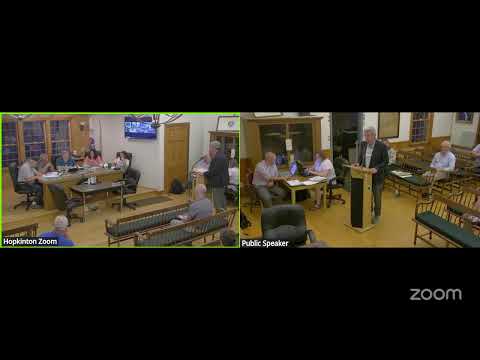
Planning Board continues Skunk Hill Solar hearing after dispute over Arcadia Road excavation and viewscape limits
Summary
The Planning Board continued the Skunk Hill Solar LLC major-modification hearing to Aug. 5, requiring applicant materials by July 17. Debate centered on excavation on Arcadia Road, whether that work complies with the town's solar ordinance, groundwater testing, and competing setback/viewscape requirements set by a prior town council zone change and the board's master-plan conditions.
The Planning Board on July 1 continued a contested public hearing on a major modification to the Skunk Hill Solar master plan, directing the applicant to submit detailed technical materials and either an application for dimensional relief or expert testimony by July 17 so the board can consider the matter at its Aug. 5 meeting.
The applicant and its consultants presented plan changes and engineering responses to staff comments, while abutters and the town solicitor pressed the board on whether proposed excavation on the Arcadia Road portion of the site is allowed under the town's solar ordinance. Town consultant Steve Cabral said technical changes in the latest submission were largely minor and that the applicant had agreed to correct plan details, but he highlighted outstanding items including landscaping, reforestation plan consistency, clarifying stormwater details, and a required solar-field operations and maintenance document. "They've agreed to actually flag out all of the noise producing equipment as well as the inverters," Cabral said, adding that the drainage operation-and-maintenance plan had been submitted but the solar-field O&M still needed to be provided.
Applicant representatives said the Arcadia Road excavation is intended to reuse on-site soils to build the berms required by earlier approvals and to reduce truck traffic. "There's several reasons why we did the excavation... that helps us eliminate 4,000 trips of truckloads coming in and out," said Sarah Bridal of Transy and Associates. Martin Riedel of EDP, the project's sponsor, said winter and seasonal-high testing found the water table around 15 feet, and that planned excavation of roughly six feet would remain well above that level: "we found it at 15 feet... we're taking off 6 feet plus minus, and so we're still 8 feet or 9 feet above the water table." The applicant also said it had reduced the number of panels proposed and had revised layout to reduce impacts.
Board members and the town solicitor pushed back on whether the planned regrading fits the ordinance language that limits ground leveling "to those areas needed for effective solar energy collection" and requires existing soils to be "maintained to the maximum extent practicable" when a parcel was rezoned for solar. The town solicitor advised the board that, in his view, the ordinance's first sentence likely prevents the proposed excavation and that the board cannot waive a zoning ordinance; he said the applicant may need to seek a dimensional variance. "I believe the first sentence prevents this from occurring," the solicitor said, noting the board's authority is distinct from the town council's zoning powers.
Neighbors and an elected official urged caution and more time for review. Robert Byrne, vice president of the town council, asked why staff had limited time to review late-submitted materials and urged stipulations to protect abutters: "You are protecting what the town council's decision is... put stipulations on all projects that you possibly can to protect everybody." Several residents said the combination of berms, tree buffers and individually targeted mitigation should be evaluated house by house.
The applicant proposed mitigation approaches for viewscapes that included planting 12-foot berms with evergreens and performing individual viewscape analyses from affected homes; the applicant offered a path of targeted mitigation for homes with remaining impact rather than a blanket increase in setback standards. The applicant also said it had modeled stormwater to a 100-year event and offered to phase berm construction early so abutters and the board could assess the actual view impact once berms are in place.
After extended discussion among counsel, consultants and the public, the board voted to continue the Skunk Hill Solar hearing to Aug. 5 and asked the applicant to deliver full materials for any requested dimensional variance or expert testimony and a plan for individual viewscape assessments by July 17 to be added to the August agenda.
What's next: The applicant must submit the specified materials by July 17. The board will revisit the matter at its Aug. 5 meeting; parties may pursue a dimensional variance if the board concludes zoning language prevents the proposed excavation.