Get Full Government Meeting Transcripts, Videos, & Alerts Forever!
Get email alerts on the Master Plan topic
No spam. Unsubscribe anytime.
Ridgefield strategic planning committee to weigh grade‑configuration, pre‑K expansion and $197–$200M facility needs
Summary
MP Planning and district leaders told the April 24 Strategic Planning Committee that the district faces roughly $197–$200 million in forecasted facility needs and will pursue site analysis, financial modeling and community engagement over the summer, with a goal to return recommendations to the full board in the fall.
At a Strategic Planning Committee meeting on April 24, consultants from MP Planning and Ridgefield School District officials outlined next steps for a district master plan that will assess grade-configuration options, pre-K expansion, long-term capital needs and fiscal constraints.
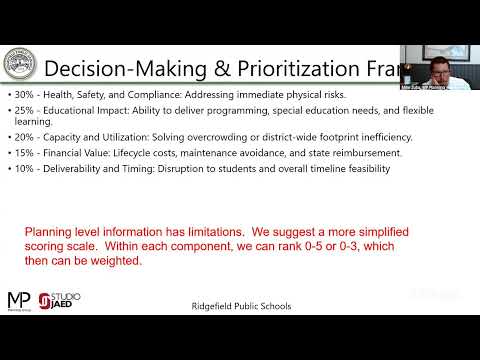
The consultant team said the district is facing roughly $200 million in forecasted needs (the administration later referenced a $197 million figure for capital and operational improvements). Pat and Mike of MP Planning told the committee they will deliver site analyses and a pros-and-cons assessment of planning scenarios (status quo, targeted additions, reimagined footprint or blank‑slate redesign) for the committee’s June 12 meeting and said the group should expect an increased meeting cadence through the summer to narrow options.
Finance questions took central stage: consultants recommended early coordination with town officials to identify any debt-service caps or competing town projects that could constrain bonding capacity. Pat said at this planning level consultants will not produce detailed tax-impact numbers but can craft a reasonable framework once the committee supplies a focused list of town questions. Administration agreed to work with the town and gather requested financial and capital-history documents so consultants can estimate the funding gap between capital requests and approvals.
Committee members asked for two modeled scenarios to share with the public: (1) a short-term, priority‑one list of health, safety and code items (the near-term work that must be done regardless of long‑term choices), and (2) a steady‑state projection showing the fiscal implications if current operating and capital patterns continue over the next 10 years. "If we don't do anything, we still have to do these kinds of things," a committee member said, noting that a visual summary of the consequences would help public understanding.
The consultants also encouraged the committee to clarify pre-K goals. Dr. De Silva said Ridgefield’s preschool program currently centers on students with identified learning differences and suggested the committee decide whether to (a) keep that focus and centralize production for efficiency, or (b) expand toward a community/tuition model that could generate revenue and broaden access. The team will develop estimates of additional classrooms and space needs under different program philosophies.
On grade configuration and footprint, members debated whether to consider consolidating smaller elementary schools and whether to explore a single middle school, noting Ridgefield’s geographic spread and transportation implications. MP Planning said it will test enrollment and geographic data to assess whether larger consolidated schools make sense for efficiency and education quality.
The consultants said they aim to take narrowed recommendations to the full Board of Education in mid-to-late fall, after the committee uses June site analysis and summer deliberations to reduce options. The committee also agreed to collect any additional high‑level options by the end of the following week so consultants can research them ahead of the June meeting.
The meeting closed with a routine motion to adjourn that passed by recorded affirmation from several members.