Get Full Government Meeting Transcripts, Videos, & Alerts Forever!
Get email alerts on the Urban Forestry topic
No spam. Unsubscribe anytime.
Harbor Springs tree board to revise ‘2025 management plan for trees and vegetation,’ delay formal public hearing
Summary
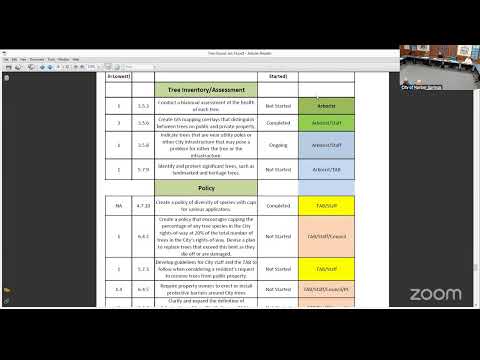
The Harbor Springs Tree Board reviewed and edited a draft management plan, agreed on planting and maintenance standards (including a 20% species cap and two-year aftercare), and tabled formal public outreach until after a new city manager starts.
The Harbor Springs Tree Board reviewed a draft “2025 management plan for trees and vegetation,” agreed on several edits to planting and maintenance standards and decided to delay a formal public hearing until after a new city manager is in place.
During old-business discussion, board members identified inconsistent file versions of the draft (one copy bore a Feb. 6, 2024 signature but referenced 2020 bylaws) and asked staff to reconcile the versions before forwarding the document to council. Board members debated whether the title should read “trees,” “vegetation,” or “trees and vegetation,” and agreed to keep “trees and vegetation” for clarity and scope.
Board members agreed on several specific provisions to add or clarify in the draft: a three-year rotating inspection by the Department of Public Works across three mapped sectors to identify dead or hazardous trees, a clause allowing out-of-cycle interventions for dangerous trees, a 20% cap on any single species to promote diversity, and a requirement that new plantings have two years of aftercare using a gator irrigation bag with a clearly assigned responsible party.
A resident who identified their address as 465 State Street asked whether the city has an overall streetscape plan for that block and offered to help with funding or neighborhood contributions; the board said the streetscape item was on their radar and would be addressed in the draft revisions.
The board acknowledged the value of a public input town-hall but several members said it would be more productive to wait until a newly hired city manager could participate to avoid rework and improve turnout. By consensus the board asked the staff member to incorporate the agreed edits, circulate the revised draft and include it in next month’s meeting packet for review; the board will schedule public outreach after the new city manager has had a chance to review the plan.
Next steps: staff will reconcile the file versions, update the recommended-tree list to the May 2025 reference, add the agreed language (inspection cycle, hazard response, species cap and aftercare), and place the revised draft on the next packet for board review before any formal public hearing or council submission.