Get Full Government Meeting Transcripts, Videos, & Alerts Forever!
Get email alerts on the Fleet Management Policy topic
No spam. Unsubscribe anytime.
Douglas County staff present updated fleet policy, tighten license checks and restrict take‑home vehicles
Summary
Douglas County fleet manager presented a streamlined fleet‑management policy that strengthens driver‑licensing checks, restricts take‑home vehicle eligibility to emergency responders and formalizes Fleet Management Council duties; staff said they will seek board ratification (presenter suggested the 23rd; month not specified).
John Solano, Douglas County fleet manager, presented a streamlined county fleet‑management policy at an Administrative Services meeting, saying the revision responds to internal audit findings and is intended for board ratification by resolution.
Solano told commissioners the new policy tightens driver eligibility and verification. "Each county driver shall be at least 19 years of age and drive responsibly," he said, and described a verification process that will include annual self‑validation on an FMC form coordinated with Human Resources and reviewed by the county attorney’s office.
The policy would bar drivers with more than two moving violations in the previous 36 months or more than one at‑fault accident, Solano said. He described the Fleet Management Council as composed of "the fleet manager myself, purchasing agent Eric Carlson at the time and the risk manager Matt M.," and said the council helped craft the minimum risk controls in the document.
Under the proposal, county vehicles would be driven only by authorized employees with appropriate licenses; standard operating rules would require seat‑belt use, appropriate child‑seat restraints when transporting children and a prohibition on operating while impaired. Drivers must report collisions, complete a county vehicle accident report and notify supervisors; copies of accident reports are to go to the fleet manager.
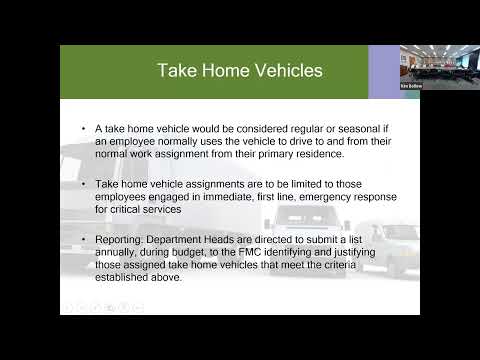
Solano said take‑home vehicles would be limited to employees engaged in immediate, first‑line emergency response — examples he cited included roads and sheriff’s personnel — and that department heads and elected officials must justify assigned take‑home vehicles annually during the budget process. He said departments could adopt internal allocation procedures so long as they did not weaken countywide standards.
When pool vehicles are used, departments will log trips with an FMC3 form and verify a valid driver’s license at reservation; when employees use private vehicles because no pool vehicle is available, reimbursement would follow the IRS mileage rate and private vehicles must meet state minimum insurance requirements for county work, Solano said.
The policy requires county vehicles to carry exempt license plates and visible county markings, with an explicit exception for undercover law‑enforcement units that must remain unmarked. Solano noted the redline evolved from a 1996 board resolution governing county assets and said the county attorney had reviewed the new FMC form language.
Solano asked staff to distribute the slides and the full policy; he suggested presenting the revised policy to the Douglas County Board on the 23rd. The presenter did not specify a month for that date in the transcript. No formal motions or votes were recorded during the meeting.
The next procedural step described in the meeting was distribution of the full policy to administrative staff and placement of the item on the board agenda for consideration.