Get Full Government Meeting Transcripts, Videos, & Alerts Forever!
Get email alerts on the Workforce Transitions topic
No spam. Unsubscribe anytime.
Panel urges displaced federal employees to consider Virginia local government and education jobs
Summary
A Virginia LGMA webinar guided displaced federal employees through job opportunities in local government and education, highlighting shortages in STEM, nursing and special education, resume translation tips, alternative licensure routes and county workforce supports including WIOA services.
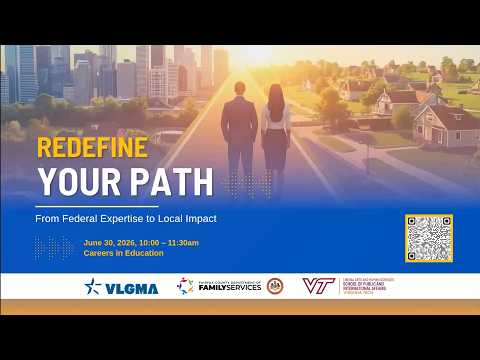
A panel of Virginia local government and education officials advised federal employees and contractors during a webinar on practical steps to pivot into local government and school-system roles.
India Adams Jacobs, president of the Virginia Local Government Management Association and town manager of Bowling Green, opened the session by noting the size of the local-government workforce in Virginia and the scale of staffing gaps: "we have roughly 25,000 vacancies statewide," she said, adding that about 7,500 of those openings are in Northern Virginia. Panelists framed the event as both a recruitment resource and a practical roadmap for career switchers.
Panelists identified persistent shortages that create hiring opportunities. Dr. Brent Via of Northern Virginia Community College said community colleges urgently need STEM instructors (including IT and cybersecurity), nursing faculty and skilled-trades instructors, and that non-instructional roles — academic advisers, grants and workforce-development staff — are also in demand. Jonathan Mandina of Lowden County Public Schools said K–12 divisions seek science, technology and math teachers, special-education staff, and operational roles such as transportation, nutrition and facilities trades.
Speakers emphasized translating federal experience into education language. "Use data to identify trends and improve organizational decision-making," Mandina said as an example of reframing federal work into concrete outcomes schools value. Panelists advised shortening federal résumés, highlighting program outcomes and partnership experience, and using keywords like student outcomes, equity, program evaluation and workforce development.
On pathways into classrooms and campus roles, the panel described multiple routes: adjunct teaching at community colleges (often accepted with a master’s, PhD or 18 graduate credits), provisional K–12 licenses that allow applicants to teach while completing tests and coursework, and state-approved alternative certification programs. The panel noted that provisional special-education pathways can be completed with a short three-credit course and that some online alternative programs cost about $3,000 and award an I‑Teach provisional credential.
Fairfax County and other divisions offer direct applicant support. A Fairfax speaker pointed users to recruit@fcps.edu for follow-up and recommended checking the Virginia Department of Education shortage listings for state-level guidance. Tatiana Nuth of Fairfax County Workforce Development described local services under the Workforce Innovation and Opportunity Act (WIOA) designed to help displaced federal workers: individualized career coaching, help converting federal résumés to local formats, access to credentialing supports, paid work-based learning opportunities and dedicated job fairs.
Panelists closed by encouraging attendees to build teaching portfolios, seek adjunct or substitute roles to gain classroom experience, and explore career-switcher or graduate-certificate programs (including a 12-credit local government management certificate highlighted by Virginia Tech) as pathways to full-time local-government or education careers. Organizers said a recording and a follow-up email with resources and QR codes would be shared with registrants.
The webinar combined staffing data, concrete hiring guidance and programmatic resources; attendees were directed to local HR contacts, Virginia Department of Education shortage lists and Fairfax County workforce centers for next steps.