Get Full Government Meeting Transcripts, Videos, & Alerts Forever!
Get email alerts on the American Revolution topic
No spam. Unsubscribe anytime.
Nathaniel Philbrick at James Madison lecture: Washington’s political skill and the French navy as keys to Yorktown
Summary
At the James Madison Memorial Fellowship Foundation’s 29th annual lecture in Arlington, author Nathaniel Philbrick argued that George Washington’s political leadership and the French navy’s victory in the Chesapeake were decisive to the American victory at Yorktown, and urged teachers to convey the Revolution’s contingency to students.
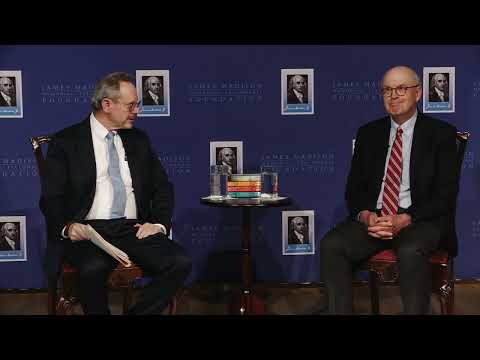
Nathaniel Philbrick told attendees at the James Madison Memorial Fellowship Foundation’s 29th annual James Madison Lecture in Arlington, Virginia, that George Washington’s political skill — not only his military leadership — and the French fleet’s control of the Chesapeake were decisive in bringing about the victory at Yorktown.
Philbrick, the author of several books on the Revolutionary era, told a room of secondary-school teachers and foundation fellows that naval superiority altered the strategic balance in 1781. "Admiral Degrasse's fleet established naval superiority," he said, and by denying the British naval access the French made Cornwallis’s position untenable and the siege of Yorktown possible. Philbrick said that the Americans’ success at Yorktown was as much an international achievement as a product of militia campaigns.
The lecture combined narrative history and practical classroom relevance. Earlier in the program Dr. Guy F. Bernett, chief of staff and academics at the James Madison Memorial Fellowship Foundation, described the foundation’s summer institute and the fellowship that supports it: "Each fellow receives up to $24,000 to pursue a master's degree focused on the Constitution," Bernett said, noting the institute is an intensive four-week graduate course offered through Georgetown University.
Philbrick argued Washington’s political instincts were as important as his battlefield judgment. He described Washington as a leader who learned restraint, preserved his army through wartime crises and then used public tours and personal presence to help found the presidency: "He set about on a series of road trips…he invented the presidency," Philbrick said, describing tours that aimed to build trust in a new federal government.
On the Revolution’s internal dynamics, Philbrick emphasized that the conflict contained significant domestic violence and divided communities. "It was a civil war in many places," he said, noting neighbor-against-neighbor fighting in contested areas and the long social scars that followed.
During a 15-minute audience question-and-answer session, Philbrick fielded questions on contingency, commemoration and classroom practice. Asked whether Washington’s success involved luck, Philbrick responded that fortune played a role in several turning points. Asked about Benedict Arnold’s exclusion from some memorials, he suggested nations must balance honoring achievement and confronting betrayal. In response to a teacher’s question about what students should take away, Philbrick recommended stressing the Revolution’s indeterminacy: "We almost lost this thing countless times," he said, arguing that conveying uncertainty helps students relate to the past.
The foundation invited attendees to a book-signing and reception after the program. The lecture was recorded for the James Madison Fellowship Foundation’s YouTube channel and shown to remote audiences via C-SPAN.