Get Full Government Meeting Transcripts, Videos, & Alerts Forever!
Get email alerts on the Open Meeting Law topic
No spam. Unsubscribe anytime.
Trainer walks Groveland Select Board through open meeting law, remote participation and public‑comment rules
Summary
An outside attorney led a 60‑minute training for the Groveland Select Board on Massachusetts open meeting law, covering posting rules, executive sessions, remote participation and public‑comment limits, and cited case law including Barron v. Kalinda.
Lisa Mead of Mead, Telamon & Costa led a nearly hour‑long training at the Groveland Select Board’s June 22 meeting on Massachusetts’ open meeting law, explaining statutory references, posting requirements, executive‑session procedures and limits on deliberations outside of public meetings.
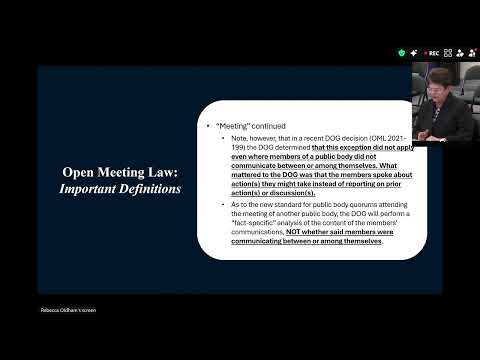
Mead told board members the law is codified in state statute and regulations—Chapter 39 and implementing rules at 940 CMR 29—and said that the Attorney General’s Division of Open Government enforces both. She reviewed who counts as a “public body,” when a gathering becomes a meeting, and why a quorum’s email exchanges on substantive matters can constitute unlawful deliberation. Mead urged boards to post adequate agendas (not simply “new business”), to preserve drafts and exhibits in a list attached to minutes, and to seek advisory opinions from the Attorney General’s office when matters are uncertain.
The training distinguished pre‑ and post‑COVID remote participation rules, noting that COVID emergency exceptions remain in place through March 2027 but that, outside the emergency framework, a quorum typically must be physically present unless a remote‑participation policy has been adopted. Mead emphasized chair responsibilities—announcing recordings and whether members are remote—and explained that roll‑call votes are required when remote members participate under the COVID rules.
Mead also reviewed executive‑session reasons (personnel, litigation strategy, real‑estate negotiations, collective bargaining, etc.), timing and required roll‑call votes to enter and exit executive session, and minutes requirements for executive sessions. She described remedies for violations, including remedial meetings, AG determinations, and, in aggressive enforcement cases, the potential to nullify actions taken in violation of the law.
Board members asked how the rules apply to visiting other boards’ posted meetings, to site visits, to the use of timers during public comment, and to the town’s online posting practices. Mead recommended posting meetings when a majority might attend another body’s meeting and explained the narrow circumstances in which site visits are exempt from normal posting.
The presentation concluded with a reminder that public‑comment policies must be applied evenhandedly once a board allows members of the public to speak, and that time, place and manner limits can be imposed but content‑based restrictions are unconstitutional once a limited public forum has been opened. The board thanked Mead and moved on to regular agenda business.