Get Full Government Meeting Transcripts, Videos, & Alerts Forever!
Get email alerts on the Infrastructure Dam topic
No spam. Unsubscribe anytime.
Consultant: Goodrich dam options range from $2 million rehab to roughly $13.5 million removal
Summary
A Wade Trim consultant laid out four options for the Goodrich mill pond dam — full removal, partial removal, rehabilitation, or replacement — with widely different cost and community impacts, and urged a prioritized list of repairs, permitting work and funding research.
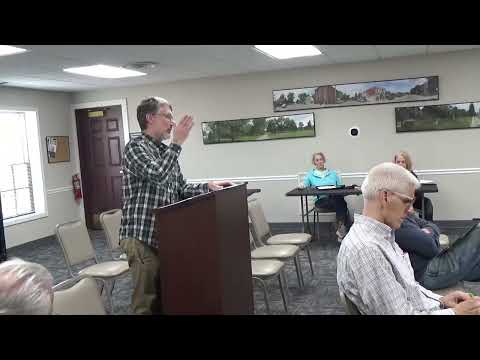
Kevin Cook of engineering firm Wade Trim presented the village with a dam feasibility study that lays out four principal options and rough cost ranges for the Goodrich mill pond structure and answered council questions during a March 9 council meeting. Cook described the options as: complete removal, partial removal, rehabilitation of the existing dam, or replacement with a new structure.
Cook said a full removal of the dam was estimated at about $13 million to $13.5 million in 2026 dollars and would likely approach $14 million if 50-year lifecycle costs were included. He said partial removal (a plan the consultant labeled “1B”) would lower water levels, narrow the impoundment and could require substantial sediment mitigation, while a full replacement was estimated at roughly $9.5 million (about $10 million with lifecycle escalation). Cook said rehabilitation — the option the village previously identified as its preferred path — was the least costly major option, with a current, updated estimate a little over $2.05 million including contingency and allowances.
Cook warned about indirect effects for the removal and partial-removal options. “If we lower the water table, the size of the impoundment would narrow down,” he said, and that change could affect nearby residential wells, golf-course ponds and, importantly, bridge foundations adjacent to the dam. He told the council that lowering the impoundment often requires bridge redesigns because exposed foundations could be destabilized if water levels drop significantly.
On construction logistics and timing, Cook said rehabilitation and replacement would require design, permitting and construction engineering; permits would likely include state and Army Corps of Engineers approvals. He estimated that, if design work started in July, construction could potentially begin the following year; overall he characterized a full project timeline as on the order of about two years from design through construction in typical conditions.
Cook described near-term priorities the engineering team recommends: removal of woody vegetation, erosion-protection upgrades, public-safety enhancements, replacement of worn gates, downstream channel armoring and concrete structural repairs where metal is exposed and cracking is evident. He noted the cost estimates include a roughly 25% contingency because of unknowns and the potential need for specialized permits or additional design work.
On funding, Cook said grant money for dam removal or major dam work is limited and often targeted to safety-related fixes. “To get full funding you typically need high political pull or an earmark,” he said, noting that local grants, low-interest loans and special assessments are other possibilities. Cook cautioned the council not to expect full grant coverage for a $13 million removal and said many grants he’s seen provide modest support focused on safety items rather than full replacement.
Council members asked about coffer dams and whether temporary measures could allow work without dewatering the impoundment. Cook explained a coffer dam holds water back while crews work on gates or concrete, but it prevents lowering the water level and therefore doesn’t address the need to move gates during large storm flows; for that reason, he said, passive spillway solutions can limit future control. He also acknowledged an outstanding task: the engineering team will examine the Atlas Mill/Atlas Mill Pond spillway and advise whether similar approaches could apply to Goodrich’s structure.
Cook said he expects to deliver the complete report and appendices in the next few weeks and offered to post the full document to the firm’s share site so council members can download the 40–50 page report and large appendices.
Next steps discussed at the meeting included staff review of the consultant’s recommended priority list, targeted follow-up on possible grant opportunities, legal review of a village agreement with the city of Flint (which could have financial implications if the pond level is changed), and scheduling design and permitting work if the council chooses a rehabilitation or replacement path.
The consultant’s cost figures and the timeline he outlined were presented as estimates; council members pressed for more cost comparisons and legal clarity on downstream agreements before settling on a preferred funding and construction approach. The council did not take any formal action to select an option at the meeting and asked staff and the consultant to provide the final report and a recommended prioritization of repairs and next steps.