Get Full Government Meeting Transcripts, Videos, & Alerts Forever!
Get email alerts on the Historic District Ordinance topic
No spam. Unsubscribe anytime.
Resident urges HARB to tighten historic-district ordinance language, calls some provisions 'secular blasphemy'
Summary
In a lengthy public comment, Thomas Paul urged the HARB to recommend specific ordinance amendments removing language that encourages contemporary design for additions and new buildings, and instead require new work to emphasize and replicate predominant historic styles; he also proposed archival requirements and changes to variance sequencing.
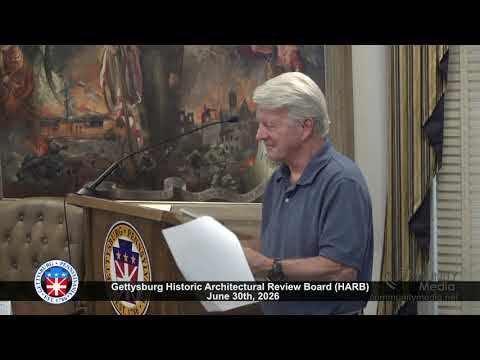
During public comment at the June 30 meeting, Gettysburg resident Thomas Paul urged the Historic Architectural Review Board to recommend a set of detailed text amendments to the borough’s historic-district ordinance that he said are needed to stop what he described as inappropriate contemporary alterations to the borough’s battlefield-area resources.
Paul—who identified himself and provided a written amendment submitted May 20, 2026—said provisions that “encourage” contemporary design for additions and new buildings have been used, in his view, to justify alterations that “desecrate” Gettysburg’s hollowed ground. He proposed striking subsections that promote contemporary design and replacing them with language that would require new buildings and additions to "emphasize the predominant and compatible historic styles and architectural features of neighboring properties" and that any contemporary differentiation be limited to minor accents shown to be necessary. He also proposed requiring that removed historic materials be “properly archived” rather than simply stored, and that applicants seeking zoning variances related to design or dimensional requirements receive zoning-board action before HARB takes final action on a certificate-of-appropriateness application.
Paul framed the changes as grounded in his “nearly 40 years of professional planning experience,” and submitted a summary of his suggested edits for the board’s consideration. Board members offered him an opportunity for questions at the end of his remarks; no immediate board action followed his public comment beyond staff acknowledgment that the written recommendations were received and would be part of the ordinance discussion.
Quoted
“I respectfully and forcefully oppose certain language within the existing historic district ordinance that has of late been used…to justify and promote what I see as a desecration of the hollowed ground in this internationally recognized historic place,” Paul said in his remarks.
What happens next
Paul’s written amendments were entered into the record and will be available to HARB and staff as the board finalizes its recommendation on the draft Chapter 11 ordinance updates. Staff asked for any additional member comments on the draft ordinance by July 7 so the HARB packet can include them for the July 15 meeting, when the board anticipates drafting a formal recommendation to borough council.