Get Full Government Meeting Transcripts, Videos, & Alerts Forever!
Get email alerts on the Historic Preservation Projects topic
No spam. Unsubscribe anytime.
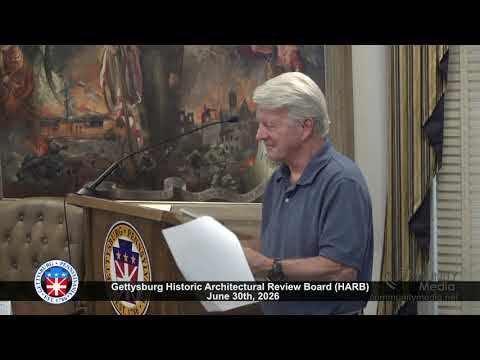
Gettysburg HARB recommends approval of three exterior projects, conditions material choices
Summary
The Gettysburg Borough Historic Architectural Review Board on June 30 recommended certificates of appropriateness for three major exterior projects — at 162 York Street, 26 East High Street and 312 Baltimore Street — imposing material and design conditions (notably specifying wood for new fences and porch columns) and forwarding recommendations to borough council.
The Gettysburg Borough Historic Architectural Review Board on June 30 voted to recommend approval of three separate exterior projects, attaching material and design conditions and forwarding each recommendation to borough council for final action.
At 162 York Street, owner Anton Hummer sought to replace 227 linear feet of rear-yard fencing and add a 14-by-14 stamped-concrete patio. Staff recommended denying a vinyl fencing material, saying it “does not meet design criteria established by the Borough of Gettysburg or the U.S. Department of the Interior Secretary standards for the treatment of historic properties,” and the board moved to approve the project on the condition that the fence be constructed of wood rather than PVC. The motion to recommend approval with that material condition was made by Suzanne Christensen and seconded; the board approved the recommendation.
At 26 East High Street, the board reviewed a larger rear-yard alteration including a new 16-by-24 patio, a masonry fireplace, replacement of first- and second-floor porch columns and railings, and a 6-by-10 utility shed. The applicant said vinyl-wrapped columns and railings would be replaced with painted Endura stone (columns), a painted wood or wood-like ceiling, a painted spindle-style railing and a wood privacy fence. After discussed proportions and appearance, the board specified columns that match the scale of the first-floor columns (about 6-inch square) and a 42-inch spindle-type railing rather than ornamental wrought iron, and voted to recommend the COA with those conditions.
At 312 Baltimore Street (the carriage-house façade), manager Ted Hurt and his team presented revised elevations after emergency shoring. The board required clarification of window divisions and door configuration (the applicant agreed to a one-over-one window on the left and a nine-light two-panel door consistent with prior direction). Staff reiterated that historic features that can be repaired should be preserved; the board approved the design as clarified and recommended the COA to borough council.
All three recommendations are advisory: borough council will consider final certificates of appropriateness at its next meeting (applicants were told to wait for council action before beginning work). The board’s conditions focused on preserving the visual character of contributing structures in the Gettysburg Historic District by prioritizing wood or wood-like finishes, compatible column proportions and traditional railing profiles.
Quoted
“[Vinyl] does not meet design criteria established by the Borough of Gettysburg or the U.S. Department of the Interior Secretary standards for the treatment of historic properties,” staff member John Whitmore said during the 162 York Street review.
“I think the port should retain the white…traditional top rail square pickets,” a board member said while arguing for a spindle-style railing at 26 East High Street.
What happens next
Each of the three project approvals is a board recommendation. Borough council must review and issue final certificates of appropriateness; applicants were advised to await council action before purchasing materials or beginning construction.