Get Full Government Meeting Transcripts, Videos, & Alerts Forever!
Get email alerts on the Crash Data And Legislation topic
No spam. Unsubscribe anytime.
Sawyer County traffic report: statewide crash counts steady, fatalities down; several new state traffic laws explained
Summary
County staff reviewed first-quarter 2026 DOT-reported crash data showing roughly 31,000 reportable crashes statewide with 76 preliminary fatalities and local Q1 totals of 78 reportable crashes in Sawyer County; presenters also summarized a set of recently enacted state laws and upcoming safety campaigns and grant programs.
County and state traffic officials presented first-quarter 2026 crash data and walked the committee through recent changes in state law and funding programs.
Dan, presenting DOT-reported figures for January through March, said the state had recorded a little over 31,000 reportable crashes in the quarter, nearly 7,000 injuries and 76 preliminary fatalities (numbers he described as subject to a reporting lag). He noted the statewide fatalities figure represents a near-term decline compared with recent annualized averages and described a five-year rolling average that annualizes to about 573 fatalities.
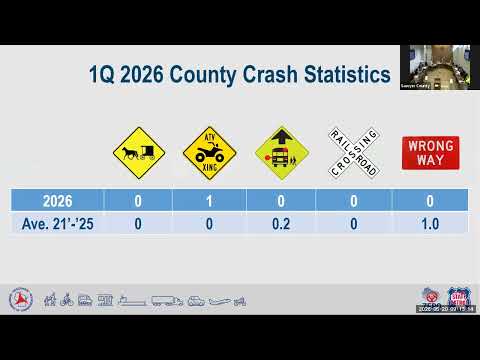
At the county level Dan said Sawyer County reported 78 reportable crashes in the first quarter and — notably — no county fatalities in that period. He flagged an increase in speed-related crashes locally and statewide (up more than 50% in the county’s first-quarter report for that crash type) and a modest rise in crashes involving drivers 65 and older.
Presenters also summarized new state statutes and provisions that affect local practice: Act 83 (raises a maximum ATV weight to 3,500 pounds), Act 89 (authorizes oral-fluid roadside drug testing using saliva devices, subject to later administrative rules and device approvals), Act 148 (requires fatality review teams at the county level), Act 160 and related acts regulating school-bus cameras and safety curriculum, Act 195 (OWI statute updates reflecting recent court rulings), and Act 210 (changes to ignition-interlock timing and occupational license waiting periods). The group noted the governor vetoed SB 699, the measure that would have allowed larger non-school buses to carry up to 15 students instead of nine.
Staff walked through upcoming safety campaigns — Click It or Ticket, impaired-driving mobilizations around holiday weekends, child passenger safety checks, and the Governor’s Conference on Highway Safety in late August — and encouraged agencies to pursue funding through programs such as HSIP (Highway Safety Improvement Program), SS4A regional efforts and the High-Risk Rural Roads Program, explaining eligibility considerations and application windows.
Presenters urged accurate crash narratives and documentation in police reports to strengthen grant applications and emphasized county-level coordination for fatality review requirements.