Get Full Government Meeting Transcripts, Videos, & Alerts Forever!
Get email alerts on the Conditional Use Permit topic
No spam. Unsubscribe anytime.
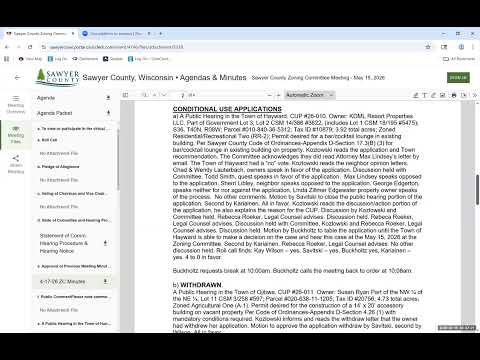
Zoning committee denies Oak Shores Resort’s conditional-use request for bar and public lounge
Summary
The Sawyer County Zoning Committee voted to deny Conditional Use Permit 26‑010 for Oak Shores Resort’s proposed 24×60-foot bar/gathering space, finding the proposed use a principal use that did not meet setback requirements and raising neighborhood impact concerns.
The Sawyer County Zoning Committee on May 15 denied Conditional Use Permit 26‑010, a request from KDML Resort Properties (Oak Shores Resort) to convert part of an existing pole shed into a 24‑by‑60‑foot cocktail lounge and occasional public gathering space.
The applicants, Chad and Wendy Lauderbach, told the committee the space would primarily serve guests and occasional private events but that they sought the CUP to permit limited public access. "We want to be clear that our intent is to not operate a traditional bar or late‑night establishment," Chad Lauderbach said, adding that the owners had measured noise and found sound levels dropped sharply outside the building.
County staff and legal counsel framed the key legal question as whether the structure and proposed use are accessory to the resort’s lodging operations or constitute a principal use that would be subject to larger setback and land‑use requirements. Rebecca Roker, legal counsel for the applicants, read the ordinance definitions for accessory and principal structures and urged the committee to assess whether the proposed use remained subordinate to the principal resort operation.
Opponents — including nearby residents and an attorney appearing online — told the committee the proposal would effectively create a public bar in a residential neighborhood and that the facility’s change of use should be treated like new development. "If this were an application to build a new 1,400‑square‑foot bar and restaurant, would you consider that accessory or principal? I think it's clear you'd say principal," attorney Max Lindsey told the committee.
Neighbors flagged traffic safety and noise concerns and said the building sits roughly 8 feet from a residential lot line and therefore fails the county setback for a principal structure. The applicants provided decibel readings intended to show limited off‑site noise, with interior readings over 100 dB and exterior measurements as low as 29 dB at the nearest neighbor’s driveway, but the committee concluded testimony and documentary evidence supported treating the change as a principal use.
Supervisor K. Wilson moved to deny the CUP on the basis that the building is a principal structure and that approval would not protect property values or nearby family life; the motion was seconded and carried on roll call. County staff advised the committee that a finding the building is a principal structure also meant it failed required setbacks and would, if approved, require a separate variance process.
The committee’s denial means the applicants must either revise their plans, pursue a variance if they still seek a principal‑use authorization, or limit the facility’s operations to activities clearly incidental to guest lodging. County staff said the record of substantial evidence from both sides is incorporated into the file and that the applicants may return with a revised application.