Get Full Government Meeting Transcripts, Videos, & Alerts Forever!
Get email alerts on the ADU Reform topic
No spam. Unsubscribe anytime.
Planning Board reviews ADU changes to comply with state Affordable Homes Act; members flag water, septic and implementation questions
Summary
The board reviewed draft amendments to make Yarmouth’s accessory dwelling unit rules match the Affordable Homes Act and 760 CMR 71.00; key changes include mandatory protected-use ADUs, a 900-square-foot cap, limits on local design controls and the removal of owner-occupancy requirements — board members asked staff to assess water/septic capacity before approving changes.
At the July 1 meeting the Yarmouth Planning Board reviewed proposed changes to the town’s accessory dwelling unit (ADU) bylaw intended to implement the Affordable Homes Act (Chapter 150 of the Acts of 2024) and its implementing regulation (760 CMR 71.00).
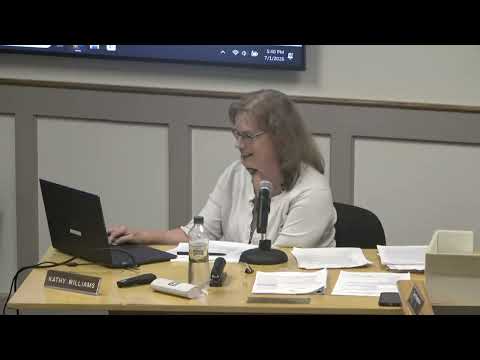
Town planner Kathy Williams said the revisions largely make the bylaw consistent with state requirements: ADUs become a protected use that a municipality must allow where single-family dwellings are permitted; the ADU size limit is set by the regulation at no greater than 900 square feet or 50% of the principal dwelling’s gross floor area, whichever is smaller; minimum lot-size and many local dimensional constraints are preempted; and local requirements such as owner-occupancy may no longer be imposed.
"This is just making our bylaw match what the state requirements are," Williams said, noting the draft retains local language only where the town is permitted to do so and removes provisions now preempted by state law.
Board members asked several implementation questions that remain unresolved: whether existing nonconforming ADUs automatically qualify as the protected ADU, how the gross building area calculation (which includes basements under the regulation) could enable what members called an effective duplex in some houses, and how increased year-round occupancy might affect local septic and water supply.
Peter Slovac urged staff to coordinate a sewer and water capacity briefing with town staff and the Select Board’s water liaison, saying planners should understand infrastructure constraints before increasing allowable housing density. Williams agreed to include water/sewer allocation in follow-up conversations and to confer with town staff (including the sewer allocation process and Lori Rosala, who handles water issues).
Other notable points in the draft: ADUs may not be held in separate ownership from the principal dwelling (to prevent condominiumization), parking rules follow the regulation (one parking space per ADU, with exemptions if within a half-mile of transit), and newly required recordkeeping and registration provisions are discussed as possible Board of Health regulations rather than zoning provisions.
Next steps: the board will revisit the ADU draft at its next meeting and expects to coordinate the review with staff and Town Council as needed.