Get Full Government Meeting Transcripts, Videos, & Alerts Forever!
Get email alerts on the Vocational Education topic
No spam. Unsubscribe anytime.
Automotive teacher at Monument Mountain says cramped 1968 shop forces program to cap enrollment
Summary
Kristen, the automotive teacher at Monument Mountain, said a small, 1968-era shop—now outfitted with grant-funded equipment—cannot safely fit rising enrollment and is capped at 15 students under state square-footage rules, forcing staff to turn away applicants and limiting long-term student projects.
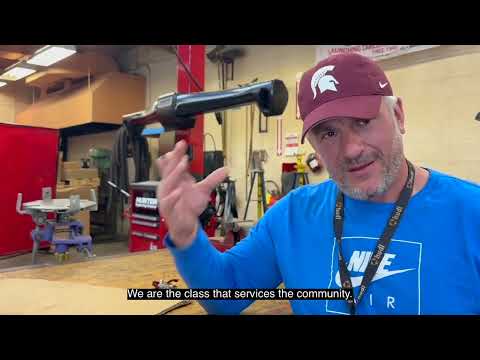
Kristen, the automotive teacher at Monument Mountain, said the school’s automotive shop, in use since 1968, is too small to safely accommodate new grant-funded equipment and a steady rise in student interest. She told attendees that the program must cap classes at about 12–15 students and has to decline some applicants when more than 50 apply.
The program received a grant that paid for equipment upgrades, Kristen said, listing a new tire-changing machine, wheel balancer, lift and alignment rack. "We were able to get a new tire machine, tire changing machine, new uh wheel balancer, a new lift, a new alignment rack," she said, adding that the shiny new machines make the old shop feel even smaller and create functional constraints for instruction.
Kristen said the tighter layout reduces safe workspace for both students and the instructor and limits the ability to run longer-term projects. "It's hard to do long-term projects. It's hard to have students work on things for a long period of time where you can't designate a spot in the shop to do that kind of stuff where it can be safe," she said, arguing that having distinct project areas for different class levels would improve safety and learning.
She cited state space requirements as an additional constraint: "there's supposed to be a certain amount of square footage in your space you know according to the state of Massachusetts based on like the type of program you have," Kristen said, noting that those standards and the program’s classification (maintenance and light repair) limit how many students the shop can legally house. That regulation, she said, contributes to the current cap of up to 15 students per class and forces the program to turn away otherwise interested applicants.
Kristen also flagged near-term logistics: a company is scheduled to install a new lift next week and the unit will require wiring and setup, tasks she said will add to the immediate operational burden. She framed the program as a community service that helps young people find local career paths and urged investment in a facility that meets instructional and safety needs despite the expense.
The account was a call for better facilities rather than a request for a specific vote or policy change recorded in the transcript. The next concrete step Kristen mentioned was the planned lift installation; there was no recorded decision or funding commitment to expand the shop in the provided transcript.