Get Full Government Meeting Transcripts, Videos, & Alerts Forever!
Get email alerts on the Zoning Text Amendment topic
No spam. Unsubscribe anytime.
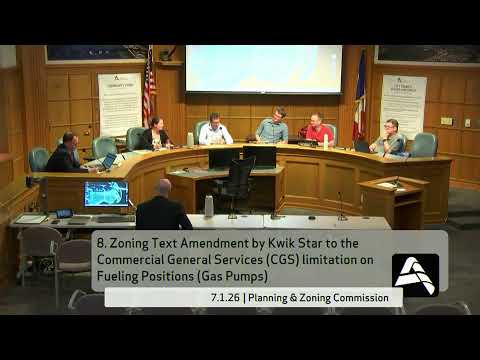
Commission backs zoning change to remove pump cap in CGS, move convenience stores to special‑use review
Summary
The commission recommended a text amendment to the CGS zoning standards that would remove the numeric cap on fueling positions for convenience stores and require each CGS convenience store site plan to undergo a special‑use (ZBA) review for neighborhood compatibility; Kwik Trip representatives said modern sites typically plan for 20 positions.
The Ames City Planning and Zoning Commission recommended that city council approve a zoning text amendment to the Convenience General Services (CGS) district that would eliminate the current numeric cap on fueling positions and direct that any convenience‑store site plan in CGS proceed through the zoning board of adjustment as a special‑use permit (SUP) rather than through an administrative staff minor‑site plan review.
City staff explained that removing the cap would allow applicants to make a site‑specific case for compatibility while the SUP process provides public notice and qualitative review criteria that are not available under an administrative approval. “The proposal is to eliminate that maximum in the CGS zone,” staff said, describing the change and the related procedural shift to SUP review.
Travis Small, a representative of Kwik Trip, said his company typically plans convenience‑store sites with 10 pumps (20 fueling positions) to meet traffic and retail needs and requested the code change so Kwik Trip can build a store of competitive size in the planned growth area. “We typically go for the 20 fueling positions,” Small said, adding that modern stores include a larger retail component and different circulation patterns than older stations.
Commissioners discussed practical tradeoffs: some voiced concern that routing all CGS convenience stores to ZBA could make approval more restrictive or administratively burdensome, while others said the SUP process offers adequate tools to judge neighborhood compatibility and was the conservative option directed by council. Several commissioners noted that CGS is a growth‑area zoning designation and does not appear in legacy neighborhoods, which affects the likely frequency of SUP applications.
A commissioner moved and seconded a recommendation for alternative 1 — removing the numeric cap and requiring SUP review for convenience stores in CGS — and the motion passed by voice vote.