Get email alerts on the Infrastructure Undergrounding topic
No spam. Unsubscribe anytime.
Public commenters press Walton County to study undergrounding utilities; staff outlines feasibility study and cost range
Summary
A series of public comments urged Walton County to prioritize undergrounding utility lines and running fiber; staff described an 'opinion of probable cost' feasibility study likely costing about $100,000–$150,000 and cited Destin’s $14 million, three‑mile phase as a comparison.
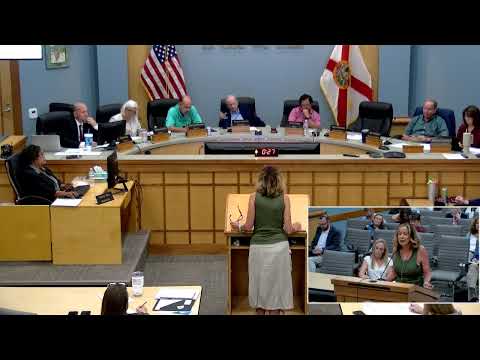
During public comment at the Walton County workshop, multiple residents urged that undergrounding overhead utilities — and installing conduit for fiber when lines are buried — be elevated from a single action item to a long‑term strategic priority.
Leemore, a longtime public participant, urged a countywide undergrounding initiative and said communities that completed such projects ‘‘can't stop talking about it’’ and reap ongoing benefits. Leemore recommended pairing undergrounding with fiber installation so the county gains more resilient communications as power lines are buried.
A staff speaker explained the standard first step is an opinion of probable cost — described as a feasibility study that identifies where undergrounding makes sense, phasing, high‑level cost estimates and potential funding sources. The staff presentation estimated that for Walton County the opinion of probable cost would likely range between $100,000 and $150,000. As a comparison point, staff cited Destin’s ongoing program and said a recent three‑mile phase of US‑98 cost about $14 million.
Staff described the key study components: prioritization criteria (need, population and economic sensitivity), geological feasibility, cost‑benefit analysis, impacts on critical facilities such as hospitals, phasing recommendations and identification of potential funding partners. Commissioners and staff discussed sequencing to avoid disrupting tourism corridors during peak seasons and noted modern directional‑boring technology has reduced surface impacts compared with older trenching methods.
Speakers emphasized funding complexity: electric utilities typically contribute but do not cover most costs, and large projects usually require multiple funding sources or grants. Staff noted only a small number of specialized firms perform such studies in Florida and recommended public participation as part of the prioritization process.
The discussion produced direction rather than a motion: public commenters urged the county to pursue a formal opinion of probable cost to put facts and figures in hand so elected officials can assess scope and funding before committing to large capital programs.
AI generated
The text on this page is AI generated. Summaries, highlights, analysis, and video transcripts are all produced from the original source material.
AI can make mistakes, so if you spot one, and we will fix it for everyone.
Note: the source content is unaltered by us. Any content source we link to, be it a video, an audio recording, or a document, is presented exactly as its publisher released it. That publisher is usually a government body, sometimes an individual official or another organisation.