Get Full Government Meeting Transcripts, Videos, & Alerts Forever!
Get email alerts on the School Finance topic
No spam. Unsubscribe anytime.
Stafford County School Board approves resolution seeking FY27 state funding, directs $2.5M to special education
Summary
At a special-called meeting after the state budget was finalized, the Stafford County School Board approved a resolution requesting FY27 state appropriations and endorsed staff recommendations that allocate $2.5 million in directed funds to special education, add counselor and targeted paraprofessional positions, and set aside one-time funds for deferred capital and operating needs.
The Stafford County School Board voted to adopt a resolution requesting appropriation of FY27 state funds and approved staff recommendations that prioritize special education, counseling and targeted operating needs.
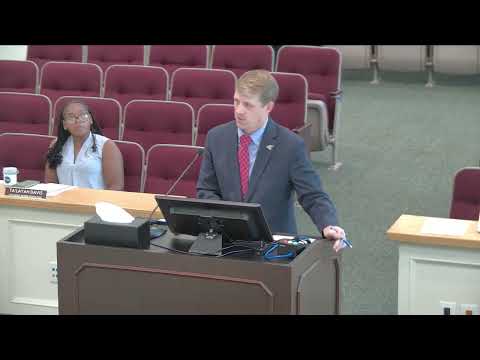
Staff presented the board with the results of the recently finalized state budget and a recommended use of the division's increase. Deputy Superintendent and Chief Operating Officer Mr. Fulmer told the board the adopted state budget includes a 4% compensation increase for SOQ positions and that the division's net increase landed at about $8.8 million when recurring and one-time items are combined. He also identified $251,000 directed for at-risk programming, $2.5 million directed to special education and $1.9 million in one-time flexible funding.
Why it matters: staff said the special education allocation would allow the division to reduce case loads and add instructional and compliance capacity for students with disabilities, a subgroup the division described as its lowest-performing cohort. Board members framed the discussion around two competing priorities: using one-time and unrestricted funds to raise staffing and services versus holding funds in reserve given enrollment declines and hiring challenges.
Mr. Fulmer recommended using the $2.5 million directed special education funds to add eight elementary Level 1 special education positions (to move toward the division's adopted 15:1 elementary staffing standard), seven differentiated staffing positions targeted to low-performing ("tier three") schools across grade bands, one central instructional support position, and 4.5 diagnostician positions (0.5 per middle school plus one central specialist) to address a rapid growth in 504 plans. "We have almost 2,200 students in Stafford County with 504s," he said when describing the compliance and case-management burden. He also proposed recruitment measures and agency support to fill hard-to-staff roles and a modest $30,000 pool to subsidize licensure pathway costs for staff pursuing special education endorsements.
On hiring and recruitment, staff explained contracted agency placements are sometimes used to fill critical roles quickly; agency hires remain employees of the contracted company and do not receive district-paid benefits, making the per-FTE contracted cost higher than a fully budgeted district FTE. Staff estimated agency support needs in the $400,000–$500,000 range and a $30,000 licensure pool for a combined ~ $530,000 recruitment/retention budget.
The presentation also recommended adding up to eight high-school counselor FTEs to move high schools toward adopted staffing ratios (250:1 target adopted in 2022), and funding cyclical bus replacements (six buses for about $890,000) and utilities adjustments as recurring needs. Staff recommended a "stairstep" approach that could include returning $1.325 million in unrestricted funds to the Board of Supervisors to acknowledge their assistance with compensation and to reduce the local appropriation request.
Board debate centered on three items: (1) whether to pursue a one-time staff bonus (staff said the state bonus concept would require a $1.79 million local match to implement), (2) concern about adding roughly 156 FTEs while enrollment was reported as down about 2.5% (a projected decline of roughly 806 students), and (3) whether agency contracting is the best retention strategy or if other incentives (stipends, targeted hiring bonuses) might be more effective for long-term retention.
"It does include a 4% compensation ... for SOQ positions for our employees," Mr. Fulmer said in his overview of the adopted budget. Several board members said they supported the special education and mental health investments; others said they worried about increasing staffing as enrollment declines and about rapid staffing decisions made on an expedited timeline after the state budget was finalized.
After discussion and brief clarifying questions, the board voted on the resolution to request appropriation for FY27 state funding. Chair Dr. Warner announced, "The motion carries 4 to two," approving the draft resolution and the staff recommendations that were incorporated into it. The meeting then adjourned.
What the board approved (as described in staff materials and discussed at the meeting): $2.5 million directed to special education (staffing, diagnostician and central support); $251,000 at-risk directed funds (used for some middle-school safety/security officers); $1.9 million in one-time funds to be allocated for deferred FY26 projects pending further FAB C discussion; recruitment/agency support budget of approximately $400k–$500k plus $30k for licensure pathway support; proposed addition of counselor and transportation replacement FTEs; and a staff recommendation that the board consider returning $1.325 million in unrestricted funds to the Board of Supervisors to lower the local appropriation.
Missing or not specified in the transcript: the record does not identify which board member moved or seconded the motion; individual roll-call votes by name were not recorded in the transcript (the result was announced as 4–2, with Miss Randall and Mr. Keshi noted absent earlier in the meeting). The timeline for implementation, detailed job descriptions for the added FTEs, and any contract details for agency providers were left to staff for follow-up.
Next steps: the adopted resolution will be sent to the Board of Supervisors for appropriation; staff said the supervisors have a July meeting and then next meet after school starts, so some items will require timely supervisor action or later FAB C review. The board adjourned after the vote.