Get Full Government Meeting Transcripts, Videos, & Alerts Forever!
Get email alerts on the Debris Management topic
No spam. Unsubscribe anytime.
Kerr County approves TDEM land-use agreement for debris-processing site at Hill Country Youth Event Center, 3-2
Summary
The Kerr County Commissioners Court voted 3-2 June 30 to approve a land-use agreement with the Texas Division of Emergency Management allowing temporary debris-processing operations on about 4.4 acres at the Hill Country Youth Event Center; commissioners emphasized contractor reclamation obligations and community impacts.
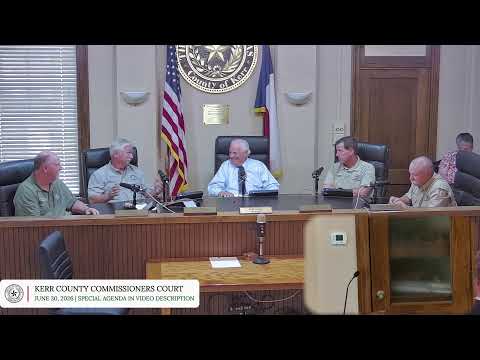
Kerr County commissioners on June 30 approved a land-use agreement allowing the Texas Division of Emergency Management (TDEM) to use part of the Hill Country Youth Event Center for temporary debris-processing operations, a measure that passed on a 3–2 vote.
Brandy Ashby, who identified herself as the TDEM Region 6 assistant chief, told the court the operation would use a single ingress-and-egress point at “gate five,” stage dry and wet debris on a grassy area adjacent to the parking lot, and limit use of asphalt areas. Ashby said TDEM would follow Texas Parks and Wildlife guidance on vegetative material and that wet debris would be dried and flipped at processing stations before further handling. “My name is Brandy Ashby. I'm the TDEM Region 6 assistant chief,” she said while describing the planned layout and equipment, which includes excavators and chippers.
Commissioners and speakers said the move responds to a much smaller ongoing footprint compared with earlier emergency staging on about 100 acres at a Center Point ISD site. County officials said the new footprint at the youth event center is roughly 4.4 acres in a narrow L-shaped area east of the outdoor arena and emphasized a goal of returning the school site to normal before classes start.
Several commissioners raised concerns about reclamation and whether taxpayers could face additional costs. Ashby told the court that contractual reclamation obligations require contractors to restore property to its original condition and that additional reclamation costs are part of contractor responsibilities; she also said she could provide contract-payment details later if requested. A member of the public, Harry Holt, identifying himself as a Center Point taxpayer, urged clarity about excavation, liner costs and whether moving the site would shift costs to taxpayers: “My biggest concern is is it going to cost taxpayers more money to move this site somewhere else because of the liner?” he said.
The court debated the language that binds contractors to restore sites and discussed previous damage reported at the Center Point location. Attorneys had reviewed the land-use agreement and told the court the agreement is ready to go once attachments showing the exact property portions to be used are added. After a motion to approve was made and seconded, the court voted three in favor, two opposed, and the motion passed.
Next steps identified by the court included finalizing attachments and maps for the agreement, circulating maintenance and reclamation details from contracts for review, and ensuring communication with Center Point ISD and neighborhood stakeholders about timing and mitigation measures.