Get Full Government Meeting Transcripts, Videos, & Alerts Forever!
Get email alerts on the Zoning Text Amendment topic
No spam. Unsubscribe anytime.
Stratford zoning panel rejects proposal to allow higher-density “transit-adjacent” housing on Broadbridge Avenue
Summary
After more than two hours of public comment and staff review, the Stratford Zoning Commission voted not to adopt a revised text amendment that would have allowed RM1-level density in RS4 parcels adjacent to RM1 near transit, and then denied an associated special-permit and site-plan for an 18-unit townhouse proposal at 2803 Broadbridge Avenue.
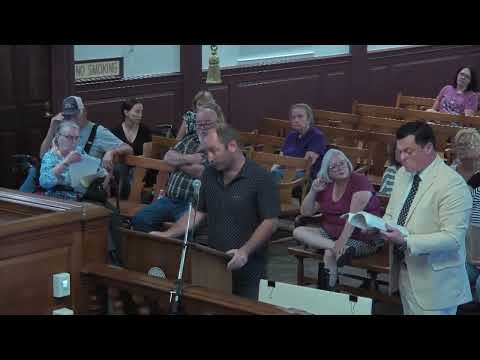
The Stratford Zoning Commission declined a proposed zoning change on July 1 that would have allowed higher-density, transit-adjacent development on certain RS4 parcels and then denied the related 18-unit townhouse permit application.
The contested proposal, filed by 2803 Broadbridge Avenue LLC, sought to add a “transit-adjacent density adjustment” to Section 5.1 of the town zoning regulations so qualifying RS4 lots could be developed to the dimensional standards of the RM1 multifamily district when several criteria — including adjacency to RM1 and proximity to an existing transit stop — were met. The applicant, represented by attorney (Attorney Herbs) and developer Tim Shapiro, said the change would enable for-sale “middle housing” consistent with Connecticut’s HB8002 and could earn the town housing-credit points from the state.
Opponents, including nearby residents and the Stony Brook Gardens cooperative, argued the revised draft departed materially from the version reviewed by the Planning Commission, raised traffic and pedestrian-safety concerns, threatened privacy and neighborhood character, and would allow developers to build by right where review and special-permit oversight had previously applied. Multiple speakers and Planning Commission chair Joseph Garrick told the Zoning Commission the Planning Commission had reversed its earlier positive recommendation after reviewing the revised draft, citing two material changes: the apparent removal of a special-permit requirement and unclear transit-stop language.
Planning & Zoning Administrator Susita Ata presented a detailed staff report outlining procedural and technical problems with the revised filing. Ata told the commission the June 9 revised draft had not been submitted as a hard copy to the town clerk as required, that application materials remained incomplete in March and June submittals (missing items included a full-size survey, certain agency signoffs and an architectural-review-board referral), and that the amendment did not clearly state which RM1 dimensional standards would apply. Staff also said the Department of Housing’s guidance on HB8002 point calculations was still evolving and that the draft, as written, did not plainly demonstrate eligibility for those credits.
Town attorney Patricia Sullivan advised the commission that the Planning Commission referral rules in Connecticut General Statutes require planning review before zoning action and that, because the Planning Commission issued an unfavorable recommendation, the zoning commission would need a supermajority to adopt the amendment. After discussion and a roll-call vote on a motion to deny the revised text amendment (moved by Commissioner Misty Persfield, seconded by Commissioner Peter Carroll), the recorded tally was 3–2 in favor of denying the amendment. Commissioners and counsel then discussed whether a four-vote threshold applied given Planning’s negative recommendation; in practice the commission treated the amendment as not adopted.
Because the proposed 18-unit townhouse special-permit and site-plan application relied on the text amendment, the commission declared that application no longer applicable and proceeded to take comments. After hearing additional public remarks, the commission voted to deny the special permit and site plan by unanimous vote (5–0).
What the commission cited in its denial - Procedural filing irregularities: staff said the revised draft submitted by email on June 9 had not been filed with the town clerk in hard copy as required by statute. - Draft ambiguity: the amendment did not clearly identify which RM1 dimensional standards (two–three unit vs. four-or-more unit standards) would apply and contained unclear transit-access wording (the 500-foot sentence and how to identify qualifying stops). - Elimination of oversight: the revised draft appeared to remove the special-permit requirement that otherwise would provide discretionary review and conditions. - Unknown geographic reach: staff and commissioners said the proposed definition of transit access made it difficult to determine how many properties townwide could qualify.
Voices in the meeting - Developer Tim Shapiro and counsel defended the proposal as a way to enable for-sale middle housing and said they would work with state agencies to secure credits under HB8002. Shapiro noted nearby multifamily developments and argued the project was compatible in context. - Planning & Zoning Administrator Susita Ata detailed missing application materials and procedural concerns and recommended the commission consider whether the record supported adoption. - Planning Commission Chair Joseph Garrick and many residents said the revised draft differed materially from the version planning had reviewed and urged the commission to preserve local review protections.
Next steps: The commission closed the special meeting after the votes. The denial of the amendment means the associated proposal for 18 townhouses cannot proceed under the revised text as written. Commission staff noted that an applicant can return with a substantially different proposal, but the commission and staff emphasized that future submissions should be complete, comply with filing requirements, and clearly identify any statutory or regulatory basis for claimed state credits.
The Zoning Commission scheduled its next regular administrative meeting for July 8 and the next public hearings and administrative meeting for July 22, 2026.