Get Full Government Meeting Transcripts, Videos, & Alerts Forever!
Get email alerts on the School Finance topic
No spam. Unsubscribe anytime.
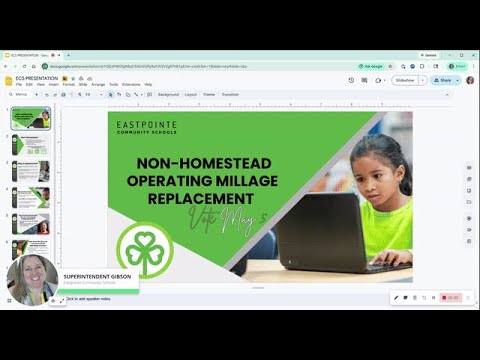
Eastpointe superintendent urges approval of nonhomestead millage replacement
Summary
Christy Gibson, superintendent of Eastpointe Community Schools, outlined a May 5 ballot proposal to replace the district's nonhomestead operating millage, saying it would restore revenue lost to the Headlee rollback and preserve up to 18 mills of taxation authority for businesses and rental properties.
Christy Gibson, superintendent of Eastpointe Community Schools, outlined a May 5 ballot proposal asking voters to approve a nonhomestead operating millage replacement to restore levy authority the district lost after the Headlee rollback.
Gibson said the proposed measure would restore the district’s previously authorized 18 mills and includes voter authorization up to 22 mills to protect against future rollbacks; she said the district would not levy more than 18 mills in tax collection under state limits. "We generate approximately $5.7 million per year with our nonhomestead millage," Gibson said. "This $5.7 million per year represents about 15% of East Point Community Schools annual operating budget."
The superintendent explained that "non‑homestead" property excludes primary residences and instead applies to businesses, commercial properties, rental homes, apartments, second homes and industrial parcels. She said the district’s levy currently collects at a reduced rate of 16.0205 mills rather than the full 18 mills because of the Headlee rollback, a shortfall she described as roughly $74,000 a year.
Gibson described how the revenue is used: to recruit and retain staff with competitive pay and working conditions negotiated through collective bargaining; to expand curriculum and career and technical education programs; to maintain instructional technology and classroom materials; and to support athletics and extracurricular activities. She said those investments aim to strengthen instruction and keep up with changes in instructional technology.
Gibson urged residents to learn more via a QR code and the district website and provided a contact for the superintendent’s office for questions about the proposal. She asked voters to "provide your continued commitment to our school district by showing up at the polls on May 5th."
No formal vote or board action on the proposal was recorded in this presentation; Gibson's remarks were an informational appeal to the community ahead of the May 5 election.