Get Full Government Meeting Transcripts, Videos, & Alerts Forever!
Get email alerts on the Protective Order Sharing topic
No spam. Unsubscribe anytime.
Alabama Supreme Court hears challenge to protective order that critics say lets insurerdocuments circulate across cases
Summary
The Supreme Court of Alabama heard arguments in State Farm—ire & Casualty Co.—ase challenging a trial court irective that allows certain confidential insurer documents to be used in other bad-faith roof cases; petitioners warned the order lacks downstream safeguards and could bypass other courts iscovery discretion.
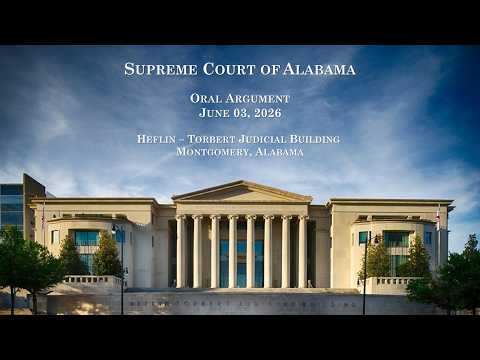
The Supreme Court of Alabama heard oral argument in SC-2025-0918 on whether a trial court—rred by entering a protective order that lets certain confidential insurer documents be used in other, related bad-faith roof cases.
Sarah Rawls, counsel for petitioner State Farm Fire and Casualty Company, told the court the order functions as distribution rather than protection because it permits proprietary materials to move beyond the present case without clear, enforceable safeguards. "That is not protection. That is distribution," Rawls said, urging the court to vacate the sharing language and direct entry of a non-sharing order.
Rawls identified two central problems: the order allows confidential materials to be used in other actions without requiring downstream attorneys or agencies to sign an agreement to be bound by the protective order, and it circumvents Alabama Rule 26 by pre-authorizing cross-case use rather than leaving relevance and proportionality decisions to each collateral court. Rawls told the justices there is no record showing the other pending cases are identical or sufficiently similar to justify an exception to Rule 26; she said plaintiffs identified about eight other cases but did not provide detailed factual support for broad sharing.
Counsel for amici, Will Courtney, representing the U.S. Chamber of Commerce and the American Tort Reform Association, urged a narrower, modification-based approach used in other jurisdictions. Courtney said courts should allow collateral plaintiffs to intervene and seek targeted modifications later, applying a presumption against modification and preserving each collateral court uthority over ultimate discoverability.
Respondent counsel Frank Wilson told the justices the order the trial judge entered is not a free-sharing directive. "We asked for a sharing order. We didn't get a sharing order," Wilson said, arguing the order lets the respondents use documents in cases where they appear but does not authorize handing confidential files to unknown third parties. He acknowledged the order's language may be ambiguous about future appearances outside Alabama and said his firm would seek clarification from Judge Smithart if necessary.
The justices pressed both sides on practical safeguards and enforcement: whether downstream recipients (including government agencies) must sign to become bound, whether a 35-day return-or-destroy clause applies to materials once the originating action is final, and how courts could enforce return or destruction if recipients never saw or agreed to the protective order. Rawls warned a lack of tracking and enforceable return obligations leaves State Farm vulnerable to irreversible dispersion before collateral courts can rule on relevance.
No formal vote or decision was issued from the bench. The justices took the petition under submission after the arguments and adjourned.
The case centers on tensions between protecting trade-secret and confidential materials and the procedural rules that tie discovery to the facts of each pending action. The court's eventual decision will determine whether trial courts may enter narrow sharing provisions like Judge Smithart's order or whether Alabama law requires more restrictive, case-specific protection or an intervening modification process.