Get Full Government Meeting Transcripts, Videos, & Alerts Forever!
Get email alerts on the Public Safety Fire Emergency Services topic
No spam. Unsubscribe anytime.
Douglas County commissioners discuss up to 4.1‑mill levy to fund 10 new CFD1 positions
Summary
At a July 1 work session the Board of Douglas County Commissioners reviewed a supplemental request for Consolidated Fire District No. 1 to add roughly 10 FTE (six firefighters, three captains and a battalion chief), heard data on falling volunteer response and longer response times, and asked staff to return July 10 with refined analyses ahead of revenue‑neutral decisions in mid‑July.
Board of Douglas County Commissioners members on July 1 heard a detailed presentation on staffing and budget options for Consolidated Fire District No. 1 (CFD1) and discussed whether to include a supplemental request that would raise the district’s revenue‑neutral levy by as much as 4.1 mills.
Sean, a county staff presenter, told commissioners the packet and supplemental request are focused on workforce stabilization and asked for direction on preparing a revenue‑neutral rate. He said the supplemental seeks to add roughly 10 full‑time equivalent positions (six firefighters, three captains and a battalion or chief officer) to reduce single‑responder deployments and improve supervision, training and community programs.
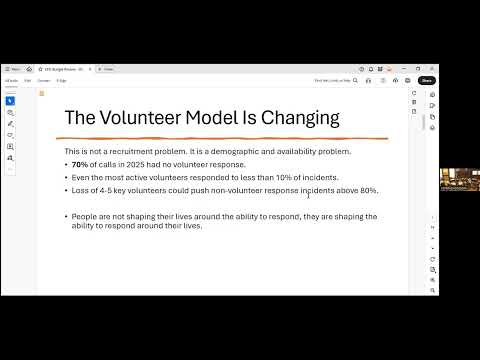
The request follows a district assessment and recent operational data that staff and chiefs said show significant strain: CFD1 covers roughly 230 square miles with 10 stations, 38 apparatus and about 1,000 calls annually; the district currently has six full‑time firefighters, two chiefs and an administrator, supplemented by about 45 volunteers. Staff cited 2025 data showing roughly 70% of calls had no volunteer response; removing the five most active volunteers raises that figure toward 80%, meaning paid staff are covering the bulk of calls in many shifts.
Chiefs and staff said the staffing shortfall has lengthened response times in parts of the district; staff noted a measurable drop in response time after earlier staffing additions at a La Compton station. District leaders described operational limits including overlapping calls, long travel distances (some GPS estimates approached 20–25 minutes between borders), and frequently operating single‑person companies, which constrain training and on‑scene safety.
Those operational factors informed the three options presented to the commission. Option A would add six firefighters, three captains and one chief officer (the full package presented); Option B would add the firefighters and captains but defer the chief officer; Option C would add only the six firefighters. Staff illustrated the relative levy impacts of each option and characterized Option A as offering the most immediate operational and supervisory benefit.
Commissioners pressed on several practical points, including recruitment and onboarding timelines, whether new hires would need to be fully trained or could be developed internally, and the district’s administrative capacity to carry out expanded training and community programs. Chiefs said recruiting full‑time firefighters is difficult—candidates in CFD1 can face being the only responder on a call—and that leadership positions are intended in part to provide on‑the‑job training and succession planning.
Grant opportunities were discussed as a complement to local funding. Commissioners and staff reviewed federal programs such as SAFER (Staffing for Adequate Fire and Emergency Response) and Assistance to Firefighters/Fire Prevention grants. Staff cautioned that personnel grants typically reduce federal support over time (e.g., a common structure is 100% the first year then declining shares) and that local sponsors must plan for the long‑term fiscal impact when grant funding steps down.
Commissioners also asked whether federal Payment‑in‑Lieu‑of‑Taxes (PILT) funds or commercial tax bases offset district costs. A commissioner noted Douglas County received $72,000 in PILT for 2026 but staff said that payment is distributed to schools and townships and not to rural fire districts; staff identified two large commercial taxpayers in the district (Barry Plastics and the Lawrence Energy Center) but said the district remains unique in its low density and long travel distances compared with nearby departments.
Several commissioners said they are inclined to prefer the fuller stabilization approach (Option A) to avoid repeated near‑term levy increases and to secure supervisory capacity along with firefighters; others emphasized the need for more specific data for residents in the district about who would pay the levy and the expected timing for hires. Commissioners asked staff to return with refined information on July 10 so the commission can decide what to publish for the revenue‑neutral rate resolution ahead of the July 15 deadline and the Aug. 26 public hearing.
No formal motion or vote was taken at the work session; the commission recessed to its 5:30 p.m. business meeting. The next steps recorded were direction for staff to refine the funding impact materials, provide additional data on acuity and call locations, and prepare materials for community outreach in advance of the revenue‑neutral hearing.